
Note: Some examples in this article are drawn from real therapeutic themes, with all personal identifiers removed to protect privacy.
Overthinking rarely announces itself as a problem at first. It often feels like responsibility — a sign that you care, that you’re thoughtful, that you’re trying to make the right decision. But for many clients we see in therapy, it slowly shifts from helpful problem-solving into something more consuming: a constant replay of conversations, an endless stream of “what if” questions, and vivid fake scenarios in your head that feel almost real. What begins as reflection turns into worst case scenario thinking, where even neutral situations spiral into imagined outcomes that rarely happen.
This experience—often described as rumination, overanalyzing, or being caught in mental loops—is deeply tied to both mental health and the nervous system’s response to stress. Research from the American Psychological Association and foundational work by Susan Nolen-Hoeksema shows that repetitive thought patterns can amplify distress rather than resolve it. In other words, the very process that feels like it should lead to clarity often leads to more confusion, more indecision, and a worsening sense of low mood. Over time, this becomes a habit of overthinking, especially in people who carry the emotional burden of being the strong one in relationships or at work.
From a therapist’s perspective, overthinking is rarely about thinking too much - it’s about being unable to let go of thoughts that no longer serve you, particularly when they are tied to past experiences, past mistakes, or ongoing stressors.
Here’s what our lead therapist Zainib’s opening thoughts on overthinking psychology:
Clients often tell me that it feels like their brain is being hijacked and they have no control over it, and they're being sucked into a world of worst-case scenarios, as well as like a motor is running, fixated and focused on solving a certain problem, and they can't turn it off.
In clinical settings, overthinking is not a formal diagnosis. It is better understood as a symptom or process that shows up across multiple mental health conditions, including generalized anxiety disorder, depression, and obsessive-compulsive tendencies. The DSM-5 framework doesn’t label “overthinking” itself as a disorder, but it clearly identifies patterns like repetitive thought, intrusive thoughts, and cognitive preoccupation as part of broader diagnostic criteria.
A key distinction we often make with clients is between rumination and worry. Rumination tends to focus on the past — replaying past mistakes, analyzing interactions, and becoming increasingly self-critical. Worry, on the other hand, is future-oriented — imagining worst-case scenarios, engaging in second-guessing, and creating detailed mental simulations of what might go wrong. Both create thought loops, but they operate in slightly different emotional spaces and are often fueled by different rumination causes, such as unresolved grief, relational insecurity, or chronic stress.
This distinction matters because treatment approaches differ. Cognitive Behavioural Therapy (CBT), for example, targets cognitive distortions like catastrophizing, while Acceptance and Commitment Therapy (ACT) focuses on letting go of attachment to thoughts altogether. In therapy, we also look at how patterns like validation seeking, people pleasing, and conflict avoidance reinforce overthinking — especially in clients who struggle with boundary setting struggles or criticism sensitivity.

Overthinking is not random. It is built from layers of cognition, emotion, and biology working together — often with the intention of protecting you, even if the outcome is unhelpful.
At the cognitive level, overthinking is fueled by entrenched thought patterns and cognitive distortions. These include catastrophizing, black-and-white thinking, and personalization. For example, a delayed reply to a message may trigger fake scenarios in your head about rejection, leading to overanalyzing and second-guessing what you said. This is especially common in individuals with criticism sensitivity or a history of relational instability.
Over time, the brain becomes conditioned to revisit problems repeatedly, creating mental loops or thought loops. These loops are reinforced each time you engage with them, particularly when they are tied to identity patterns like being the “responsible one” or carrying the emotional burden of being the strong one.
Emotionally, overthinking is closely tied to social anxiety, perfectionism, and fear of uncertainty. Many clients who overthink things are also navigating people pleasing, over apologizing, or difficult conversation avoidance, all of which increase internal pressure to get things “right.” This often leads to self-sabotaging behaviours, where avoidance replaces action, reinforcing the cycle.
In moments of heightened stress, some individuals also experience emotional flooding, where the intensity of emotion overwhelms the ability to think clearly. Ironically, this can trigger even more overthinking as the mind attempts to regain control.
From a neurological perspective, overthinking activates the brain’s threat detection systems. The amygdala signals danger, while the prefrontal cortex attempts to solve it. When this loop doesn’t resolve, the nervous system remains activated, keeping the body in a prolonged stress state. This is why overthinking often feels physical — tension, restlessness, and difficulty relaxing.
Overthinking is reinforced because it feels productive. It gives the illusion of control, especially in environments where unpredictability is high. However, instead of resolving problems, it prolongs them, creating cycles of decision fatigue, avoidance, and further indecision.
Here’s Zainib’s WHY overthinking psychology happens:
A client and I were recently discussing how his overthinking as a 30-year-old man working in corporate setting. He was incredibly adaptive working, but it was stemming from a survival response that was due to the high stress environment of this role. This led us to focusing on understanding the protective response behind his overthinking, and following those crumbs on the trail to earlier experiences. With this client, we worked backwards all the way into his past and discovered that it was a deep part of his psyche.

Many people don’t realize they’re caught in overthinking until it begins to affect their daily life and well-being. It often shows up in subtle but consistent ways that build over time.
Clinically, we assess not just the presence of these behaviours, but their frequency and impact. When overthinking begins to impair functioning or relationships, it becomes a signal that deeper intervention is needed.
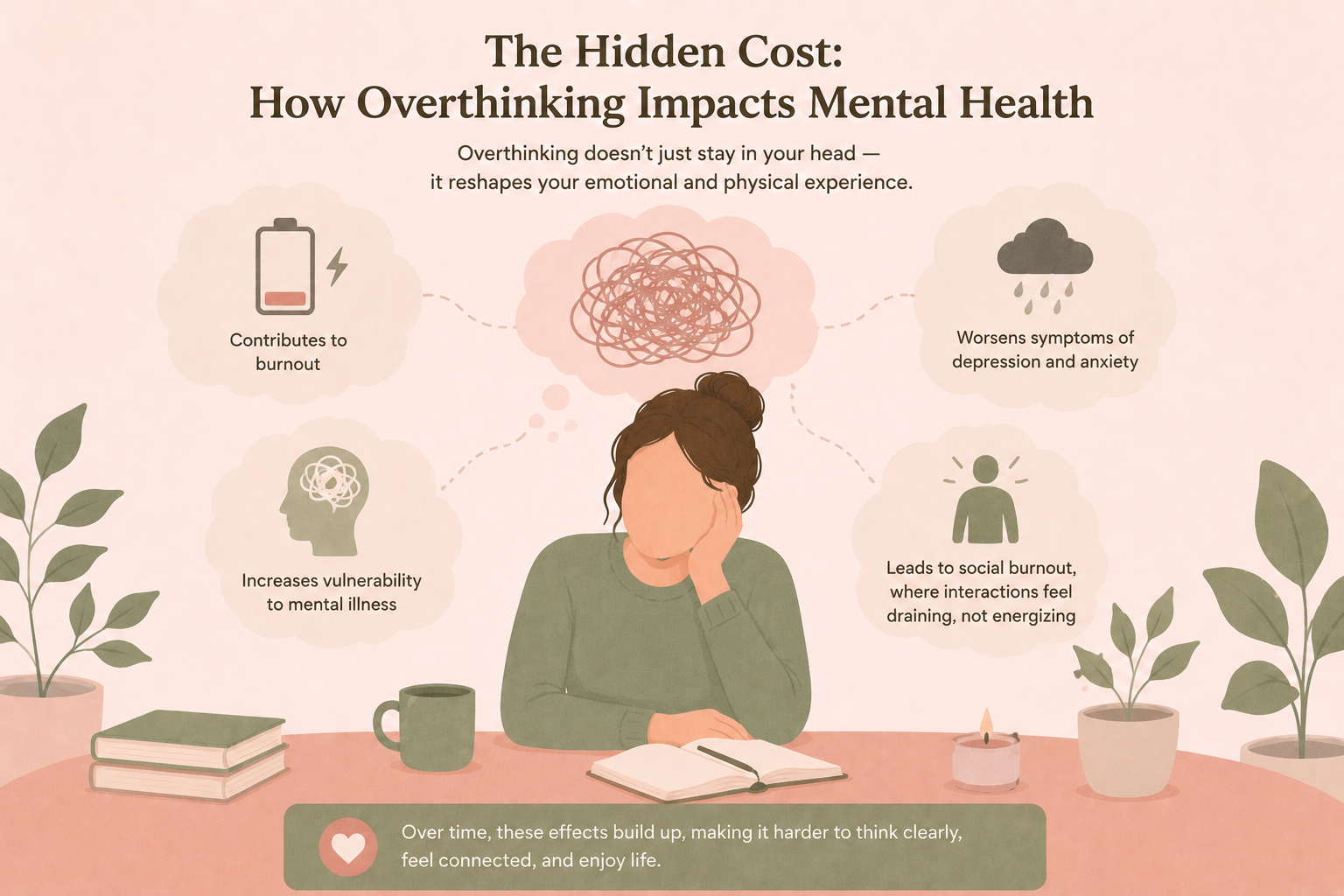
Overthinking doesn’t just stay in your head — it reshapes your emotional and physical experience. Over time, it contributes to burnout, worsens symptoms of mental illness, and increases vulnerability to depression and anxiety. This is particularly evident in individuals experiencing social burnout, where repeated social interactions feel draining rather than energizing.
There is a well-documented connection between rumination and depression. When the brain repeatedly engages in negative thoughts, it strengthens those neural pathways, making it harder to shift into adaptive thinking. Clients often describe feeling trapped in thought loops, unable to disengage even when they recognize the pattern.
Here’s what our lead therapist Zainib thinks about this:
Oftentimes, without actually looking at this response and understanding the protective drive, if we just meet it with judgment or try to shut it down, or try to engage it more and more, it could create a lot of loops that are never ending, specifically around trying to resolve this issue that may never ever get resolved. What’s happening is that your system has perceived a threat, but you are engaging with it using a protective response, instead of trying to understand it more and to offer different reframes from a place of presence, care and compassion. You need to focus on being gentle with yourself when overthinking starts, not judgemental.

Helping someone stop overthinking isn’t about forcing silence in the mind. It’s about changing your relationship with your thoughts and the behaviours that sustain them.
CBT focuses on identifying and challenging negative thoughts and cognitive distortions. Clients learn to reframe these thoughts by evaluating evidence and exploring alternative interpretations. This is especially helpful for individuals who are highly self-critical or prone to validation seeking.
Mindfulness-based approaches train attention back to the present moment, interrupting mental loops. This is particularly effective for individuals experiencing emotional flooding, as it helps regulate the nervous system before addressing cognition.
One of the most effective strategies is moving from analysis to action. For clients stuck in difficult conversation avoidance or conflict avoidance, taking small, intentional steps toward action reduces indecision and builds confidence. This also helps reduce self-sabotaging patterns.
Sleep, movement, and reducing information overload all support the nervous system. Without these, even the most evidence-based cognitive strategies struggle to work. Consistent self-care practices help restore baseline emotional regulation.
Here’s an example of how Zainib helped a client:
One of the things that I know helped my client, who is in her late 20s and working in a fintech field, while she was really overwhelmed with a lot that was happening at her work, and that usually activated this response of overthinking being hypersensitive, and we really needed to look at her whole day and how her nervous system was being managed, from sleep and eating as well as movement. She found that she was not sleeping with and didn't have a routine that was supporting good sleep, which made her more grumpy during the day, which also led to more vulnerability around overthinking. As well as something that was really helpful in her specific case was to look at her blood sugar and how inconsistent eating was actually leading to a lot of increased bouts of anxiety that for her looked like overthinking. When she started to balance her diet but also avoid the high spikes of sugar as well as sleep, she found a significant decrease in rumination. Lastly, what really helped is, of course, understanding some of the history of the protective mechanism, but mostly it was movement. When she was overthinking, we offered her ways to get the right and left brain working together in what is sometimes called bilateral stimulation in EMDR. Bilateral stimulation can be experienced when going for a walk. So, when she began to overthink or spiral; she’d go for a walk to become more present, focusing on the actual walk and not her internal turmoil.
There is a point where overthinking moves beyond a habit and becomes clinically significant. If it consistently interferes with functioning, relationships, or emotional stability, it may be connected to mental health conditions such as generalized anxiety disorder or depression. It is also common in individuals navigating attachment dynamics, such as being emotionally unavailable or engaging with partners who are.
At that stage, healthcare support becomes essential. Therapy provides structured, evidence-based approaches to address both the symptoms and the underlying patterns driving them.

In therapy, the goal is not to eliminate thinking but to change your relationship with it. This includes understanding how past experiences, relational dynamics, and identity patterns shape your thought patterns.
CBT helps restructure thinking. ACT supports detachment from thoughts. Trauma-informed approaches address deeper emotional drivers. Together, these approaches create space between you and your thoughts, making letting go possible and improving overall well-being. We support patients in less traditional markets like Ottawa and London Ontario; all the way to the largest metropolitan areas like Winnipeg, Calgary, Edmonton, Vancouver, Toronto and Halifax.
At Wellnest, therapists often help clients understand that overthinking is not a failure of willpower — it’s a learned pattern that can be unlearned, book a free consultation now!
Coping with overthinking involves recognising when your mind is stuck in mental loops rather than effective problem-solving. Techniques like grounding, mindfulness, and cognitive reframing help interrupt repetitive thought cycles, while reducing behaviours like people pleasing or over apologizing can address deeper triggers. Many clinicians also recommend reducing stimulation and engaging with calming inputs, such as listening to a mental health podcast.
Overthinking is rooted in attempts to manage uncertainty and emotional discomfort. The brain generates repeated thoughts to anticipate outcomes, especially when dealing with stressors or unresolved emotions. However, research shows that excessive rumination increases distress, reinforcing cycles of anxiety and low mood.
The 3-3-3 rule is a grounding technique often referenced by organizations like Anxiety Canada (https://www.anxietycanada.com). It involves identifying three things you can see, three things you can hear, and moving three parts of your body. This helps redirect attention from intrusive thoughts to the present moment.
The biggest challenge is that overthinking feels productive but actually reduces clarity. It leads to decision fatigue, indecision, and increased self-critical thinking. Over time, it erodes confidence and contributes to burnout.
Beating overthinking requires changing patterns, not suppressing thoughts. Techniques like CBT help reframe thinking, while behavioural strategies reduce self-sabotaging tendencies like avoidance. Addressing underlying issues like perfectionism or social anxiety is key.
Relaxation starts with regulating the nervous system. Breathing exercises, movement, and reducing stimulation help calm physiological responses. Without this, cognitive strategies are less effective.
Overthinking is excessive, repetitive thinking that does not lead to resolution. It often includes overanalyzing, replaying past mistakes, or imagining future scenarios. While it feels like problem-solving, it typically reinforces distress.
Reducing overthinking involves awareness of triggers, interrupting thought loops, and practicing mindfulness. Therapy can help address underlying drivers like boundary setting struggles or validation seeking.
Rumination is a form of overthinking focused on the past. It involves repetitive analysis, often with a self-critical lens. Research by Susan Nolen-Hoeksema highlights its strong link to depression.
Overthinking itself is not a diagnosis, but it is associated with several mental health conditions. Persistent patterns may require professional healthcare support.
A toxic work environment introduces chronic stressors that increase overthinking, burnout, and social burnout. Employees may engage in worst case scenario thinking or avoid interactions through conflict avoidance.
Yes, grief can manifest later as rumination, intrusive thoughts, or emotional distress. These delayed responses often connect to unresolved emotional processing.
Imagining worst-case scenarios is common in anxiety-driven overthinking. It is often an attempt to prepare for uncertainty but increases distress.
Triggers include uncertainty, past experiences, relational dynamics, and personality traits like perfectionism. Patterns like validation seeking or criticism sensitivity can also contribute.
Yes, chronic rumination is strongly linked to depression and anxiety. It reinforces negative thoughts and emotional distress.
Constant overanalysing often stems from fear of making mistakes or losing control. It may also be reinforced by past outcomes that felt unpredictable.
Triggers vary but often include uncertainty, stress, and emotional discomfort. Management involves awareness, cognitive restructuring, and behavioural change supported by therapy.
Join our Nest to learn more about:


