
Note: Some examples in this article are drawn from real therapeutic themes, with all personal identifiers removed to protect privacy.
Rumination is a pattern of repetitive thinking, often focused on distress, mistakes, regrets, unresolved conversations, or problems that feel emotionally unfinished. It can be triggered by stress, uncertainty, difficult experiences, and certain mental health concerns. While reflecting on problems is normal, rumination tends to feel stuck: the thought process repeats, but it does not bring relief, resolution, or a clearer path forward. Instead, the mind circles around the same material until the person feels more anxious, more self-critical, or more emotionally exhausted than before. The American Psychiatric Association describes rumination as repetitive thinking about negative feelings and their causes and consequences, noting that it can contribute to or worsen depression and anxiety.
At Wellnest, therapists often hear rumination described in the language of everyday life rather than clinical terminology. A client may say, “I keep replaying what I said,” “I know I should let it go, but I cannot,” or “I am exhausted from thinking about it, but my brain will not stop.” This is especially common in people dealing with social burnout, where the mind is already overloaded by emotional labour, decision fatigue, relationship uncertainty, and the pressure to manage how others perceive them. Rumination may sit alongside patterns such as over apologizing, conflict avoidance, validation seeking, and people pleasing psychology, particularly when someone has spent years trying to keep the peace at the expense of their own emotional clarity.
This article was developed with input from Wellnest.ca therapists to help readers understand why rumination happens and when it may be helpful to seek support. It is educational in nature and should not replace medical advice, assessment, or care from a qualified mental health professional, physician, therapist, or other healthcare provider.
Here’s what our lead therapist Zainib thinks of this ailment:
Many of the clients I support often share that sometimes they feel like they are totally being taken over by an onslaught of thoughts, just a barrage of thoughts that they are experiencing inside that are usually either being critical or going over the scenario, maybe socially, or if there was a mistake that was made, that absolutely shuts down their nervous systems and makes it so hard for them to focus, but also stay regulated.
Rumination is a form of repetitive thinking in which a person becomes mentally stuck on distressing events, negative emotions, or unanswered questions. It may involve replaying mistakes, reviewing conversations, analyzing another person’s tone, or asking “Why did this happen?” without ever arriving at a meaningful conclusion. In contrast with useful reflection, ruminating thoughts usually do not create new insight. They intensify distress while giving the illusion that more thinking will eventually produce certainty.
A person may ruminate after a work meeting, a difficult text exchange, a conflict with a family member, or an awkward moment with a friend. They may go over the same interaction again and again, imagining what they should have said differently or constructing fake scenarios in your head about what others now think of them. This can become especially painful when the person already struggles with criticism sensitivity, social anxiety, or low self-esteem. Research in clinical psychology describes rumination as a form of repetitive negative thinking that can help maintain a wide range of mental health conditions, including depression and anxiety-related symptoms.
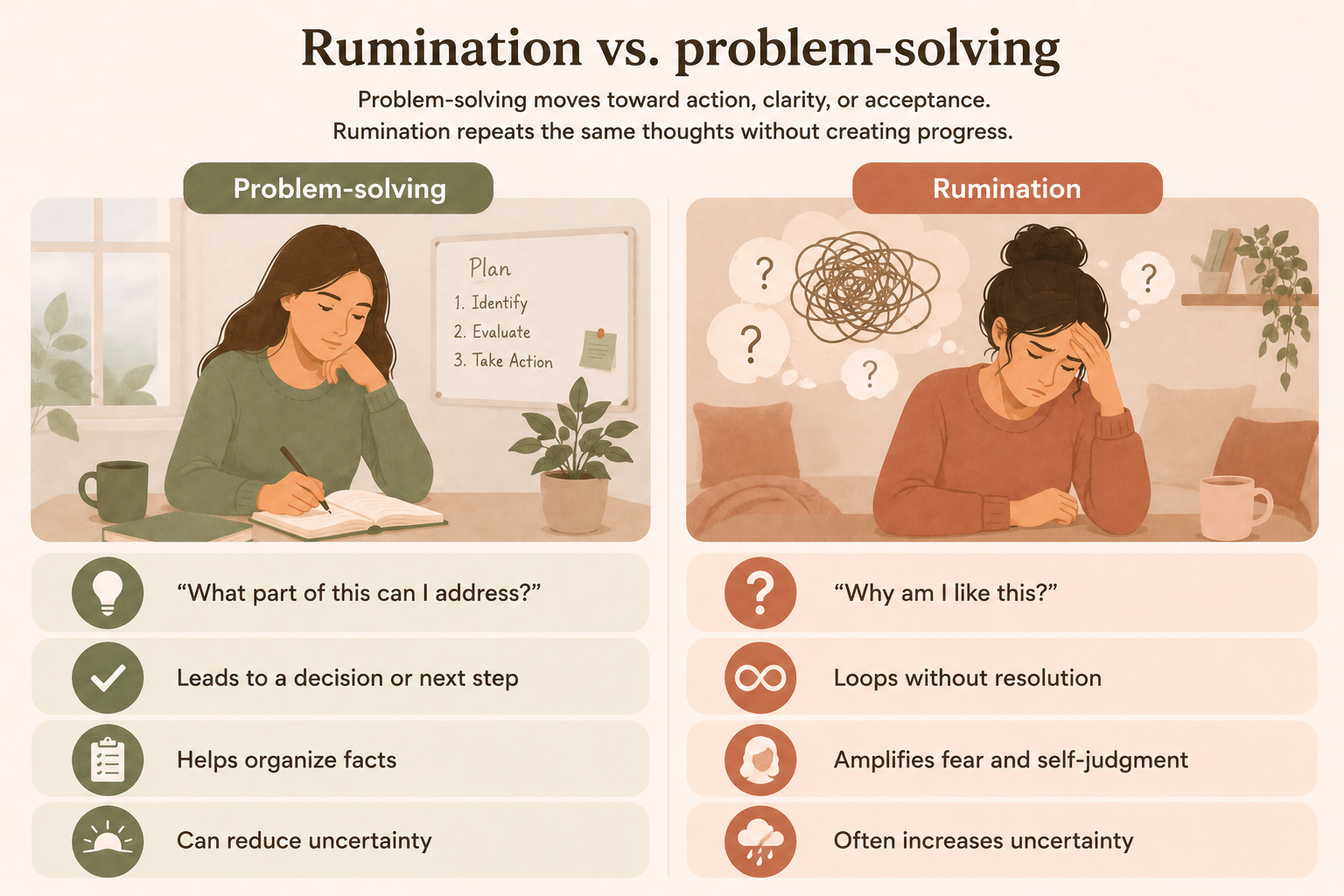
Problem-solving moves toward action, clarity, or acceptance. Rumination repeats the same thoughts without creating progress.
The difference matters because rumination often presents itself as responsibility. A person may feel that if they stop thinking, they are being careless, avoidant, or unprepared. But when a person ruminates, the mind is not always working toward a solution; it may be caught in a cycle of rumination that reinforces negative thought patterns and keeps the body in a state of mental strain.
The phrase rumination causes can sound as though there is one simple explanation, but therapists rarely see it that way. Rumination tends to emerge from a combination of internal vulnerabilities and external stressors. A person may be naturally more self-reflective, more sensitive to rejection, or more prone to negative thinking; then a period of chronic stress, conflict, uncertainty, or emotional overload gives the pattern something to attach to. The result is not just “thinking too much,” but a repetitive attempt to regulate discomfort that gradually starts making the discomfort worse.
Research suggests that rumination can act as a bridge between stressful events and later symptoms of depression or anxiety, including among adolescents and adults. One longitudinal study found that rumination helped explain how stressful life events contributed to later depressive and anxious symptoms. Another review describes rumination as a transdiagnostic process relevant across multiple mental disorders, rather than a pattern exclusive to one diagnosis.
Rumination can emerge when the mind is trying to make sense of difficult or overwhelming emotions. Work pressure, financial concerns, relationship conflict, family tension, caregiving demands, and major life changes can all create enough internal strain that the brain keeps returning to the most emotionally charged material. This is especially common when the person does not have enough recovery time, emotional support, or confidence that the situation can be handled. The mind keeps circling because it interprets the issue as unfinished.
This is where Social burnout becomes clinically relevant. Someone may spend the entire day monitoring how they are coming across, responding quickly to others, absorbing tension in a group, or managing the mood of a loved one. By night, the external interaction is over, but the internal processing is not. The person may replay a friend’s brief reply, a colleague’s facial expression, or a partner’s distant tone, asking themselves what they did wrong. Their exhaustion is not only social; it is cognitive and emotional.
A client example might look like this: someone attends a family dinner already feeling depleted from work. During the evening, a relative makes a lightly critical comment about their choices. They laugh it off in the moment, but later spend hours reviewing the exchange, imagining better comebacks, wondering whether everyone agrees, and criticizing themselves for not responding differently. The trigger was a small social moment, but because the person was already carrying emotional labour and low emotional bandwidth, it became the centre of a prolonged mental loop.
Here's Zainib's take with one of her clients:
I remember how one of my clients who worked in a tech company described how extended he was because of the overload in his company, and the expectations that are placed on him with work. He sometimes had to work really long hours and found himself really easily irritable, having problems sleeping, concentrating in his daily life. He had only been at this job a few months, and it was already impacting all of his day-to-day. We explored with him how when our nervous systems are actually overloaded by external demands, and that our priorities are in balance with our demands, it's very normal to then start to experience and be more vulnerable to overthinking and rumination.
Rumination often overlaps with anxiety, especially when a person is trying to mentally prevent future mistakes or negative outcomes. Rumination tends to focus more on past or present distress, while worry is often more future-focused, though the two can blend together in lived experience. For instance, someone may ruminate about a mistake they made yesterday and then worry that it will damage their job, their relationship, or others’ opinions of them tomorrow. Research differentiating worry and rumination supports this general distinction, while also showing that both are associated with distress and may be relevant to depression and anxiety.
This pattern can be especially strong in people with generalized anxiety disorder, social anxiety, or a broader anxiety disorder profile. They may repeatedly scan for signs that they have made a mistake, disappointed someone, or failed to anticipate a threat. A delayed message can become a story of rejection. A neutral comment can activate criticism sensitivity. A period of silence in a relationship can generate elaborate fake scenarios in your head about betrayal, abandonment, or being “too much.”
In therapy, the goal is not to shame the person for wanting reassurance. Often, their nervous system is trying to create certainty in situations where certainty is impossible. But when certainty-seeking becomes repetitive analysis, checking, or reassurance loops, the thought process may begin to resemble compulsive mental effort rather than useful reflection. That is one reason rumination can be so exhausting: it promises safety but rarely delivers it.
People experiencing depressed mood or symptoms of depression may be more likely to dwell on losses, mistakes, perceived failures, or the question of why they feel bad. A person may repeatedly revisit past negative events, compare themselves to others, or interpret current struggles as evidence of personal inadequacy. This does not mean rumination always signals depression. Rather, research suggests that rumination can be associated with low mood and can worsen or prolong emotional distress when it becomes habitual. The American Psychiatric Association notes that rumination can contribute to the development of depression or anxiety and worsen existing conditions.
Consider a person who has had several difficult social experiences in a short period: a friendship feels strained, work feedback stings, and an emotionally important message goes unanswered. Instead of seeing these as separate experiences, the mind begins weaving them into a single negative story: “People do not really like me,” “I always ruin things,” or “I will end up alone.” Rumination helps build that story by repeatedly returning to evidence that supports it while overlooking contradictory information. In this way, a negative mood can shape the content of rumination, and rumination can then deepen the negative mood.
Perfectionism can make rumination especially persistent because the person is not simply reviewing what happened; they are evaluating whether they performed acceptably. This may show up as repeatedly checking whether a decision was correct, reviewing an email after sending it, mentally rehearsing conversations before they happen, or regretting how they phrased something hours after the interaction ends. The deeper fear is often not just “I made a mistake,” but “A mistake means I am irresponsible, unlikeable, or disappointing.” That meaning makes it harder to let the thought pass.
Decision fatigue can make this worse. When someone has already spent the day making high-stakes choices, navigating demands, and monitoring everyone else’s needs, even small uncertainties can feel intolerable. A casual invitation becomes a complicated decision about energy, obligation, and guilt. After choosing, the person may ruminate about whether they disappointed someone, whether they should have said yes, or whether their explanation sounded rude. What looks like indecision may actually be a mind trying to recover from too much emotional and cognitive load.
The mind often returns to things left unsaid. Arguments, awkward moments, missed opportunities, and situations shaped by Conflict Avoidance can all become fertile ground for rumination. Someone may replay the moment they stayed silent, apologized too quickly, or agreed to something they did not actually want. If they also have a pattern of Over Apologizing or Validation Seeking, the unresolved event may become less about the original situation and more about whether they remain acceptable to the other person.
A common mini-case looks like this: a friend repeatedly cancels plans, and the client feels hurt but says, “No worries!” to avoid seeming demanding. Later, they spend the evening ruminating about whether they are overreacting, whether the friend cares at all, and whether speaking up would make them look needy. The thought loop persists because there is a real relational issue, but the person’s usual coping mechanisms prevent direct clarification. In this way, rumination may be a signal that a boundary, grief, or unmet need has not yet been acknowledged.
Rumination can be reinforced by negative self-beliefs such as “I always mess things up,” “People are judging me,” or “I should have known better.” When self-esteem is already fragile, everyday ambiguity may be interpreted through a self-critical lens. A minor mistake becomes proof of incompetence. A partner’s withdrawal becomes evidence of being unlovable. A social misstep becomes confirmation that one is awkward or burdensome.
This is one of the reasons criticism sensitivity matters so much in social burnout. A person does not need to receive harsh criticism to feel exposed; even mild correction can activate a disproportionate internal response. They may then spend hours in ruminative thinking, reconstructing the scene and scanning for signs that others have changed their opinion of them. Over time, this can affect relationships, confidence, and willingness to participate in ordinary parts of daily life.
Some people repeatedly revisit painful experiences as the mind attempts to process what happened. However, distressing repetitive thoughts after trauma are not always “rumination” in a simple sense. Depending on the person’s experience, they may overlap with intrusive thoughts, intrusive memories, hypervigilance, or symptoms associated with post-traumatic stress disorder. This distinction matters because trauma-related thinking is not merely excessive analysis; it may involve the nervous system reacting to perceived danger long after the original threat has passed. Research on repetitive negative thinking recognizes its relevance across trauma-related distress, but clinical nuance is important.
A person who has experienced betrayal, emotional abuse, or a frightening event may return to the memory in an effort to identify what they missed. “How did I not see it?” “What should I have done?” “How can I make sure this never happens again?” These questions can be understandable after painful negative experiences, but when they become relentless, they may keep the person emotionally tied to the event rather than helping them heal. A trauma-informed therapist can help distinguish reflective meaning-making from a thought loop that is maintaining distress.
Rumination often grows in the absence of safe relational processing. When people do not have a trusted person to talk with, or when they fear being judged for needing reassurance, their thoughts may cycle internally for longer. This can be especially painful in relationships with emotionally unavailable partners, where ambiguity, inconsistent responsiveness, or emotional distance leaves the person continually trying to decode what is happening. The mind fills in the gaps with speculation, self-blame, and imagined explanations.
For someone already prone to People pleasing Psychology, the question may not be “What do I need?” but “How do I stop them from being upset?” If they sense that a loved one is withdrawing, they may overanalyze every interaction and ignore their own exhaustion. The cost is not only emotional. Rumination can reduce the capacity to sleep, work, engage socially, and feel grounded in the present moment. It transforms a relationship challenge into a full-time internal monitoring task.
Rumination can become an automatic response to distress. Something upsetting happens. The person turns inward. Thoughts repeat. Distress increases. The loop becomes familiar, and the mind reaches for it more quickly the next time discomfort appears. This is why the cycle of rumination can feel self-reinforcing even when the person understands that it is not helping.
From a neuroscience perspective, researchers have examined how repetitive self-focused thinking may involve brain networks associated with self-referential thought, though the science remains developing and should not be oversimplified. Clinically, what matters most is that habitual negative thought patterns can become easier to enter and harder to exit without intentional interruption or support. A person may not choose to ruminate in a deliberate sense; the mind may simply default to that route whenever it encounters emotional uncertainty. Review work in clinical psychology describes rumination as a process that can help maintain psychopathology across several forms of distress.

Rumination feels hard to stop because it often disguises itself as responsibility, insight, or preparation. The mind says, “Keep going—you are almost at the answer,” or “If you think about this enough, you can prevent it from happening again.” This creates a false sense of control, especially after rejection, embarrassment, criticism, or uncertainty. Unfortunately, repeating the thought can intensify distress rather than solve it.
Therapists often notice that a person may believe they are finding answers, when they are actually becoming more emotionally entangled in the same pattern. Instead of widening perspective, rumination narrows attention. Instead of creating useful next steps, it amplifies negative emotions and keeps the body mentally activated. This is one reason it can contribute to emotional flooding, where the person becomes so overwhelmed by their internal state that clear thinking, self-compassion, and relational perspective become harder to access.
Rumination may also become attached to moral or relational concerns. A person may replay a conversation because they care deeply about being kind, fair, or responsible. But if that care becomes endless self-auditing, the original value gets distorted. The person is no longer acting from care; they are trapped in a self-punishing thought loop.
Here's Zainib's take on one of her clients who experienced this:
I remember one of my clients who was finishing her master's degree once told me that she was afraid. She was afraid because she thought her rumination was helpful, or that it actually was helping her think of all the worst case scenarios. When we approached it and looked at it in more detail, we realized that actually it was taking up a lot of her energy; and she was getting quite tired because she was spending so much mental energy and anxiety on this rumination. It actually prevented her from going into a zone of learning and caused her not to be able to accept that she can make mistakes. When we explored it further, we realized that this was actually a protective part of her system that needed to show up at a point in time to make sure that she doesn't make mistakes because mistakes often meant really, really negative consequences in her life and by her caregivers (due to past tramuas). So once we were able to understand the protective response, she was able to unburden that part of her and to feel a little less consumed by this rumination.

Rumination often begins with a specific trigger, even if the deeper vulnerability existed long before the event. Recognizing these triggers can help people understand why their mind becomes stuck and identify where support or new responses may be needed. The goal is not to become hyper vigilant about every possible trigger, but to notice patterns with enough clarity that they no longer feel random.
Common triggers include receiving criticism, making a mistake at work, experiencing conflict with a partner or friend, feeling socially embarrassed, or waiting for an important outcome. Uncertainty about a relationship can be particularly potent, especially when mixed with Validation Seeking or a history of rejection. Feeling excluded, misunderstood, or emotionally dismissed may also lead a person to replay events in search of an explanation. These situations do not always produce rumination, but they are frequent starting points for repetitive thoughts in people already under stress.
One example: a client notices that a close friend viewed a message but did not reply. At first, the client tells themselves it is probably nothing. But over the next few hours, they begin reviewing their last conversation, wondering whether they sounded self-centred, imagining that the friend is upset, and building fake scenarios in your head about being quietly pushed away. The trigger is small, but the underlying fear is large: “What if I am not wanted?” That is why understanding triggers matters; it reveals the emotional meaning behind the mental loop.
Rumination itself is not usually described as a standalone mental illness. Instead, it is a cognitive and emotional pattern that can occur in people with or without diagnosed mental health conditions. It has been associated with depression, anxiety, obsessive thinking patterns, trauma-related distress, and other mental disorders, but experiencing rumination does not automatically mean someone has a psychiatric diagnosis. Reviews in clinical psychology describe rumination as transdiagnostic, meaning it can contribute to distress across different diagnostic categories.
Rumination may also appear in conditions not always top of mind in public discussions. For instance, research has examined the relationship between rumination and eating disorders, with one meta-analysis finding a meaningful association between rumination and eating disorder psychopathology. Researchers have also studied repetitive negative thinking in relation to substance use, including alcohol-related coping, suggesting that these patterns may become part of broader difficulties with emotion regulation.
It is also worth clarifying that rumination disorder is a separate medical term. In healthcare and gastroenterology, rumination disorder refers to repeated regurgitation of recently eaten food, not repetitive negative thinking. StatPearls describes it as a functional gastrointestinal disorder involving effortless, recurrent regurgitation after eating.
The effects of rumination can reach into mood, sleep, concentration, relationships, and motivation. Because the mind remains preoccupied with the same distressing material, the person may struggle to redirect attention toward work, rest, or connection. They may feel more irritable, more indecisive, or more emotionally depleted. Over time, persistent ruminative thinking may worsen anxiety, deepen a negative mood, and make it harder to recover from difficult events.
A broad review of rumination and psychopathology highlights its role in the development and maintenance of psychological distress: . Research has also explored links between rumination and physical health, including stress-related physiological pathways, although the evidence is more complex and should not be overstated. One study even found that physical activity may moderate some stress-related physiological effects associated with rumination, suggesting that body-based coping may sometimes support emotional recovery.
The social consequences can be significant too. A person who repeatedly analyzes interactions may begin avoiding them altogether. They may withdraw from friends, dread group plans, or struggle to enjoy time with others because they are already anticipating the mental replay afterward. In this way, rumination can both emerge from Social burnout and intensify it, creating a loop in which connection feels needed but increasingly costly.
You may be ruminating if you revisit the same issue repeatedly without gaining new insight. You may notice that thinking makes you feel worse, not clearer, and that shifting attention elsewhere feels difficult. You may focus on blame, regret, or broad self-judgments such as “Why am I like this?” rather than on a specific next step. You may also find that the thoughts interfere with sleep, concentration, relationships, or ordinary functioning in daily life.
Rumination can also show up as endless mental reviewing: re-reading messages, reimagining facial expressions, rehearsing future conversations, or replaying your own words after a social interaction. Some people experience it as obvious overthinking; others experience it as a constant background tension that never fully turns off. If the same concern dominates your attention, pulls you away from the present moment, and does not help you make a decision or take action, it may be rumination rather than reflection.
There is no single technique that instantly makes every repetitive thought disappear. What helps depends on why the pattern is happening, how persistent it is, and whether it is connected to broader concerns such as depression, ocd, trauma, or an anxiety disorder. Still, there are evidence-based approaches that may help reduce the grip of rumination and create more flexible coping. Research on cognitive behavioural therapy, cbt, and rumination-focused cognitive behavioural therapy suggests that targeting the process of repetitive negative thinking—not only the individual thought content—can be useful in some cases.
A simple but meaningful first step is to name what is happening: “I’m stuck in rumination, not solving the problem.” This does not dismiss the concern. It clarifies that the current strategy is no longer producing movement. Naming the pattern can create a small amount of psychological distance and reduce the urgency to keep following every thought.
Rumination often asks emotionally loaded questions such as “Why did I do that?” or “Why do people always treat me this way?” These questions may feel important, but they can become too broad to resolve in the moment. Shifting toward “What now?” helps move from self-interrogation toward choice. The answer may be practical, such as writing a message, setting a boundary, resting before deciding, or accepting that there is nothing useful to do tonight.
Structured reflection can sometimes help people who feel that abandoning the thought entirely is impossible. A brief journaling period or a limited “thinking window” may help contain the loop rather than letting it spread across the day. The key is that reflection should eventually stop and lead somewhere; otherwise, journaling itself can become another form of repetitive thinking. A therapist may help a client use this strategy without accidentally turning it into a new rumination ritual.
When the mind is locked onto a feared interpretation, returning attention to the body and environment can interrupt the momentum. Breathing, sensory grounding, walking, stretching, and other forms of physical activity may help bring attention back to the present moment. These strategies do not erase the underlying issue, but they can lower arousal enough that the person is not trying to think from inside a state of emotional alarm. In situations involving Emotional flooding, that reset can be essential.
A trusted person may help a ruminating thought become more proportionate. A therapist can help even further by identifying patterns beneath the thought, such as fear of abandonment, shame, perfectionism, or habitual Conflict Avoidance. When repetitive thoughts are linked to obsessive-compulsive disorder, trauma, severe depression, or other mental health concerns, psychotherapy may be particularly important. A professional can help differentiate between ordinary stress-based rumination and patterns that require more specialized care.
Here’s Zainib’s thoughts on this:
Therapy is a wonderful way for our systems to learn about why they develop these certain responses of rumination or overthinking, for instance, to help our system learn more effective ways of communicating to build emotional regulation skills. We want to be able to go into the zones where we actually learn and where we can stretch ourselves a little bit more, and ultimately - learn a little bit more about ourselves, what makes us tick and what our values are. Once we are more aligned with this inner emotional intelligence, we can temper our reactions based on these premises.
Consider speaking with a therapist when rumination feels constant, difficult to control, or increasingly disruptive. It may be especially important if repetitive thoughts worsen anxiety, depressed mood, self-worth, sleep, work, or relationships. Professional support can also be valuable when rumination is connected to trauma, compulsive reassurance-seeking, persistent low mood, intrusive thoughts, or possible symptoms of obsessive-compulsive disorder. When self-help strategies are not enough, a trained provider can help assess what is driving the pattern and which interventions fit best.
For some people, rumination sits at the surface of a deeper emotional pattern: years of people-pleasing, fear of disapproval, living with emotionally unavailable partners, or carrying excessive emotional labour in family relationships. For others, it is more tightly linked to a recognized anxiety disorder, depression, or trauma-related symptoms. Therapy can help clarify the difference. The point is not to label every repetitive thought as pathology, but to recognize when the mental effort is costing too much.
Zainib's final thoughts:
If there is one thing that I usually share with all my clients and I hope that they take with them as they move forward in their life, is that no response, no matter how difficult it is or how much you feel it's unhelpful, is there to harm you. Your system is always working from a place of wanting to protect you, and sometimes these protective responses were developed at stages in your life where you were very young and so they're not as effective anymore now that you are much older. And the understanding is how do we offer our system a better way of being and showing up in the world that is now more aligned with our adult selves and our adult needs.
People often ruminate when they are trying to understand or gain control over something emotionally difficult. Common triggers include stressful events, rejection, conflict, criticism, regret, uncertainty, and difficult life events that feel unresolved. Research suggests rumination can also be associated with depression, anxiety, and repetitive negative thinking patterns that intensify after stress.
Therapy can help people stop ruminating by identifying what keeps the loop active and building more effective coping strategies. Approaches such as cognitive behavioural therapy, cbt, and rumination-focused cognitive behaviour therapy may help clients shift from repetitive analysis toward more flexible responding. A pilot study of rumination-focused CBT found reductions in rumination and related symptoms, though treatment should always be individualized.
Intrusive thoughts are unwanted thoughts, images, or impulses that enter the mind suddenly and can feel disturbing or out of character. Rumination is the repetitive mental engagement that may follow, such as repeatedly analyzing what the thought “means” or trying to prove it is not true. In obsessive-compulsive disorder, for example, an intrusive thought may arise first, and rumination may become a mental compulsion that attempts to reduce distress.
Rumination is associated with several mental health conditions, including depression, generalized anxiety disorder, obsessive-compulsive disorder, post-traumatic stress disorder, and some eating disorders. It can also occur in people who do not have a diagnosed mental illness. A review in clinical psychology describes rumination as a transdiagnostic process across multiple disorders rather than a symptom that belongs to only one category.
An example of rumination is replaying a conversation after a dinner with friends and repeatedly wondering whether you sounded rude, boring, or awkward. You may revisit the same sentences, imagine negative reactions, and construct fake scenarios in your head about people discussing you afterward. The key feature is that the thought repeats without creating resolution or useful problem-solving.
Obsessive rumination may require a more specialized approach, especially when it is part of ocd or obsessive-compulsive disorder. In those cases, endlessly analyzing a feared thought can function like a mental compulsion, even if it feels like “figuring something out.” Resources from the International OCD Foundation emphasize that rumination can become part of OCD’s maintenance cycle and may need to be addressed through evidence-based treatment rather than reassurance.
What causes a person to ruminate?
A person may ruminate because their mind is trying to process negative experiences, protect against future mistakes, or make sense of emotional pain. Traits such as perfectionism, low self-esteem, social anxiety, and criticism sensitivity may increase vulnerability. Rumination is also more likely under chronic stress, after negative events, or when the person lacks enough support to process what happened more directly.
Rumination is not automatically OCD or anxiety, but it can be present in both. In anxiety disorders, it may appear as repetitive analysis of feared outcomes or past interactions. In obsessive-compulsive disorder, rumination may become a mental compulsion tied to intrusive thoughts and uncertainty, which is why context matters clinically.
Rumination is a pattern of repetitive thoughts focused on distress, negative emotions, or unresolved concerns. It often involves repeatedly asking why something happened, why one feels a certain way, or what an event says about the self. Unlike productive reflection, rumination tends to keep the person mentally stuck and can worsen negative mood rather than improve understanding.
Ruminating thoughts can become harmful when they intensify distress, worsen symptoms of depression or anxiety, disrupt sleep, or interfere with daily functioning. They may also contribute to emotional isolation, decision paralysis, and reduced quality of life. If rumination is connected to suicidal thinking, severe obsessive distress, trauma symptoms, or a crisis in mental well-being, immediate professional support is important.
You can begin by recognizing the pattern, naming it, and asking whether the thought is creating clarity or only repetition. Strategies such as grounding in the present moment, setting a reflection limit, shifting from “why?” to “what now?”, and speaking with a trusted person may help. When the pattern is persistent, therapy offers more structured support and may include evidence-based approaches such as CBT or rumination-focused cognitive behavioural therapy.
No. Rumination itself is not generally considered a standalone mental illness. However, it is associated with several mental disorders and can become clinically significant when it worsens distress, functioning, or existing symptoms. It may occur in depression, anxiety, obsessive-compulsive disorder, trauma-related distress, eating disorders, and substance-related coping patterns, among others.
Rumination can be particularly problematic in OCD because it may serve as a covert mental compulsion. Instead of washing hands or checking a lock, the person repeatedly analyzes a thought, searches memory, or mentally reviews evidence to reduce uncertainty. This may briefly lower distress but ultimately keeps the obsessive-compulsive cycle active.
Postpartum anxiety refers to significant anxiety symptoms after childbirth, which may include excessive worry, hypervigilance, or distressing intrusive thoughts. Intrusive thoughts involving infant harm can be frightening, but they are not the same as intent, and they can occur in postpartum OCD or other perinatal anxiety presentations. Canadian and clinical resources stress the importance of discussing these experiences with a healthcare provider rather than suffering in silence.
The main contributors to rumination include stress, anxiety, low mood, perfectionism, unresolved conflict, regret, low self-esteem, social threat, trauma-related distress, and lack of emotional support. These factors can combine in different ways depending on the person. For instance, one person may ruminate mostly after criticism, while another may spiral after relationship ambiguity or emotionally demanding life events.
Contributing factors may include chronic stress, repetitive negative thinking habits, social anxiety, criticism sensitivity, emotional overload, perfectionism, and uncertainty intolerance. Difficult relationships, especially with emotionally unavailable partners, may also keep the mind searching for answers it cannot find on its own. Researchers have described rumination as a process that can be triggered by stress and maintained by attempts to mentally resolve emotional discomfort.
Rumination may be triggered by negative events, embarrassment, conflict, rejection, waiting for an outcome, or perceiving that a loved one has become distant. A person may also spiral after receiving criticism or making a mistake that clashes with their self-image. The trigger is often less important than the meaning attached to it: “This proves I failed,” “They are upset with me,” or “I should have prevented this.”
Some people may be more vulnerable because of temperament, prior negative experiences, anxiety, perfectionism, or learned coping mechanisms that rely heavily on analysis. Adolescents and adults who experience frequent stressors may also be more likely to fall into repetitive negative thinking, especially when emotional support is limited. A systematic review and meta-analysis on worry and rumination in young people highlights how these patterns can become clinically important during vulnerable developmental periods.
People often ruminate on negative thoughts because the brain treats them as unresolved threats or unfinished problems. The mind may believe that repeated analysis will reveal what went wrong, prevent future pain, or restore control. Unfortunately, this often strengthens the emotional significance of the thought rather than reducing it, especially when the content is tied to shame, rejection, or low self-esteem.
Common triggers include receiving criticism, making a mistake, experiencing relationship uncertainty, feeling excluded, struggling with a tense family member, or facing stressful life events. Social burnout can also lower the threshold for rumination because the person has less emotional capacity to absorb ambiguity or disappointment. A minor event can therefore become mentally sticky when it lands on top of existing exhaustion, chronic stress, or unresolved hurt.
Join our Nest to learn more about:


