
Note: Some examples in this article are drawn from real therapeutic themes, with all personal identifiers removed to protect privacy.
The experience may become more distressing when those scenarios feel repetitive, hard to control, or tightly linked to anxiety, avoidance, or emotional overwhelm. A person may spend hours building out possibilities that never happen, emotionally reacting to imagined rejection, or avoiding a real-life conversation because they have already played it through dozens of times in their inner world. In those moments, fake scenarios stop functioning like ordinary imagination and begin to resemble overthinking, catastrophizing, or a coping mechanism that no longer helps. The issue is not that the mind imagines; the issue is when imagination begins to pull someone away from the present moment, disrupt daily life, or deepen distress. The American Psychological Association defines catastrophizing as expecting the worst possible outcome from a situation, even when that outcome has not occurred
This article was developed with input from Wellnest.ca therapists to help readers understand repetitive imagined scenarios and when they may signal a need for additional support. It is not intended to diagnose a mental illness or mental disorder, and it should not replace individualized support from a qualified mental health professional or healthcare provider.
Here’s Zainib’s, our founder and lead therapist’s, opening thoughts:
One of the clients that we supported was a 37-year-old male who was working for an architecture firm and had been in his role for about six years. He was of Arab background and came into therapy because he had been experiencing a lot of anxiety around spending too much time overthinking worst-case scenarios.
Even though his job required him to consider many options while working on design projects, he found that this way of thinking had started to extend into his relationships and even normal everyday interactions. He noticed that he was spending a lot of time in his head, imagining certain scenarios and all the possible outcomes.
In therapy, we explored this with him and came to understand that the part of him that was creating all of these situations was actually a protective response. It had developed because of the environment he grew up in. He grew up in a family where his father was very unpredictable with his anger, and his mother was often the peacekeeper. She would suppress things or try to keep things contained so they would not get out of hand, and to minimize the impact of his father’s reactions.
Because of this, he always had to be on watch and stay vigilant around his father’s moods and his father’s day. He often engaged in a lot of daydreaming, but also in imagining different scenarios so he could avoid having his father’s anger directed at him or his siblings.
Once this was understood, we were able to help him heal some of that younger experience that he had been carrying. Over time, he found that the overthinking and the creating of these situations was not as strong anymore. He also began to see that this adaptive response could actually help him in his work when used in a helpful way, rather than taking over in his relationships and causing a lot of distress.
Making up fake scenarios in your head is common and not automatically a problem. These scenarios may serve emotional, protective, creative, or preparatory functions, especially during uncertainty or stress. They can become more concerning when they are repetitive, anxiety-driven, emotionally intense, or disruptive to real-world decision-making. Grounding, journaling, reality-checking, and taking a real-world step when possible may help interrupt the loop. Therapy can support people who feel stuck in distressing thought patterns, anxious “what if” spirals, or avoidant fantasy-based coping.
Making up fake scenarios in your head means imagining events that have not happened, predicting how someone might react, replaying possible conversations, or building emotional storylines that exist entirely in the mind. These scenarios may be distressing, comforting, practical, romantic, defensive, or dramatic. Someone might mentally rehearse a confrontation before seeing a difficult relative, imagine finally saying the right thing to a dismissive coworker, or picture an idealized future with a person they are interested in. These internal stories can range from fleeting moments to elaborate scenes that carry strong emotional weight.
Psychology research describes mental simulation as the mind’s ability to imagine events, actions, and outcomes that are not currently unfolding. This process can support planning, emotional preparation, and decision-making, but it can also become unhelpful when imagined outcomes repeatedly reinforce fear or avoidance.
Not every imagined scenario is a mental health concern
A scenario in the mind is not automatically pathological. In many cases, imagination helps people anticipate similar situations, rehearse language, process emotion, or explore possibilities before acting. What matters clinically is the function and impact of the experience. If imagined scenarios help a person prepare and then return to the present, they may be adaptive; if they intensify fear, pull the person away from action, or become compulsive, they may deserve closer attention.
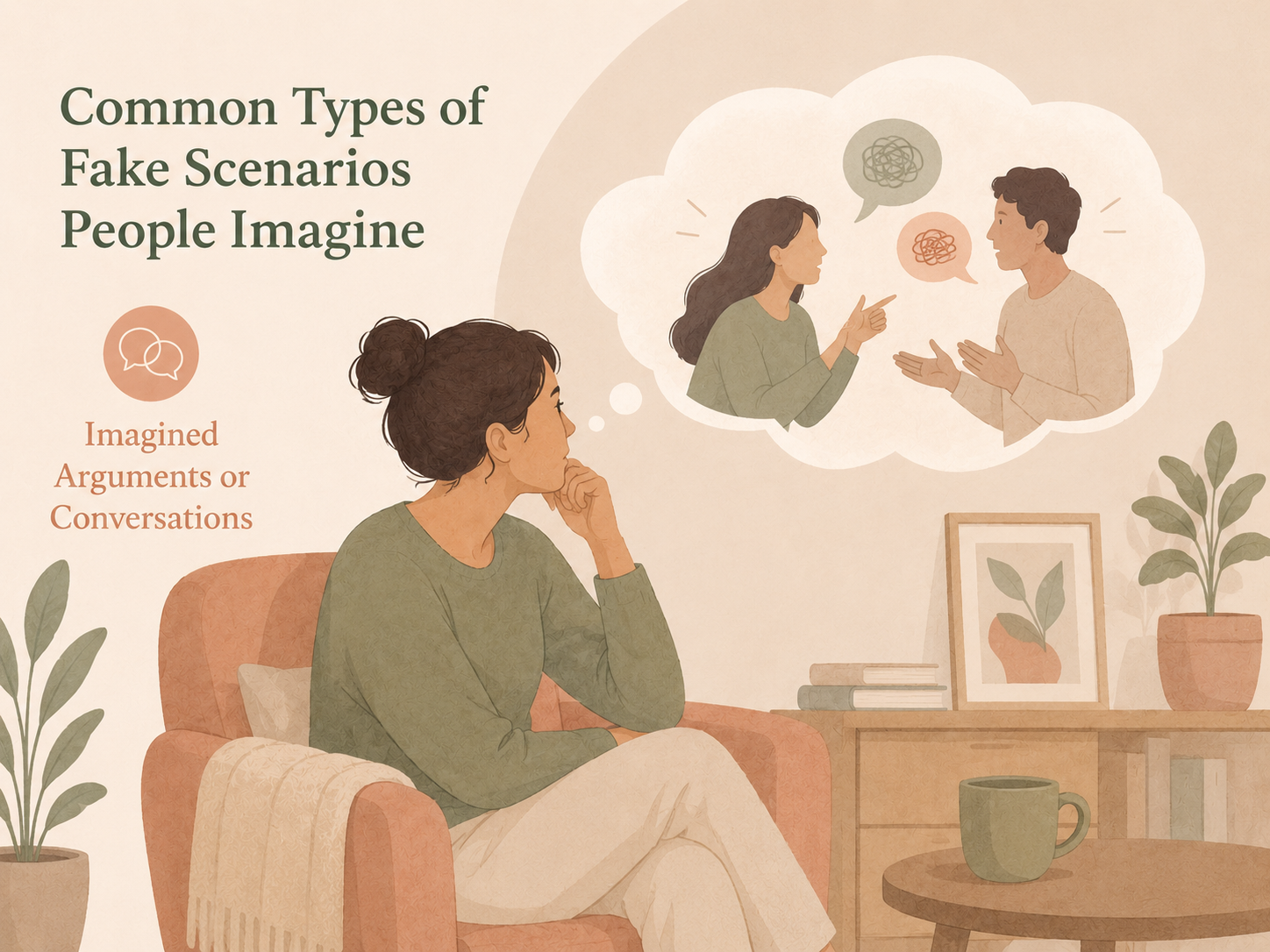
One of the most common forms of fake scenarios in your head is the imagined conversation. A person may rehearse what to say if someone confronts them, defend themselves against anticipated criticism, or script a difficult interaction word for word before it happens. This can be especially common in people who struggle with criticism sensitivity, Conflict Avoidance, or People pleasing Psychology. The mind prepares because it fears being caught off guard, misunderstood, or unable to respond effectively in the moment.
Consider a person who receives a vaguely tense message from a loved one: “We should talk later.” Nothing more is said, but the person spends the afternoon imagining every possible version of the conversation. In one version, they are accused of being selfish. In another, the relationship ends. In another, they deliver the perfect explanation and finally feel understood. By the time the actual conversation happens, they are already emotionally exhausted, and the mind has turned uncertainty into a full internal drama.
This type of mental rehearsal can feel like problem-solving, but it does not always function that way. When it helps clarify what matters and leads to a calm real-world response, it can be useful. When it becomes repetitive, emotionally escalating, and disconnected from available evidence, it may feed anxiety rather than reduce it.
Some fake scenarios are built around threats. A person imagines a minor mistake leading to humiliation, a delayed reply meaning abandonment, or a bad symptom becoming the most catastrophic possible diagnosis. This future-focused pattern is often described as catastrophizing: assuming that the worst plausible outcome is likely, imminent, or unavoidable. The American Psychological Association defines catastrophizing as “exaggerating the negative consequences of events or decisions,” especially by expecting the worst possible result.
These worst-case scenarios can feel protective because they create the illusion of preparedness. If the mind rehearses every disaster, perhaps nothing will catch it off guard. But emotionally, this strategy can become costly. The body may respond to the imagined scene as though it were already happening, leading to stress, tension, sleep disruption, or emotional flooding.
A small example can reveal the pattern. Someone submits a report and notices that their manager has not replied by the end of the day. Instead of concluding that the manager is busy, the mind constructs a sequence: the report was terrible, the team is disappointed, a formal meeting is coming, and employment is at risk. None of this has occurred. Yet the person’s emotions are responding to the internal simulation as though the threat were already unfolding.
Not all fake scenarios are frightening. Some are soothing, hopeful, or emotionally gratifying. A person may imagine the perfect romantic conversation, future success, an apology they wish they would receive, or a moment of recognition that feels absent in their real-world life. These scenes may offer relief during loneliness, boredom, disappointment, or periods of Social burnout. They can become a private emotional refuge when daily life feels demanding or unrewarding.
There is nothing inherently wrong with pleasant imagination. The mind often seeks comfort when a person is tired, under-supported, or longing for connection. However, if idealized scenarios begin replacing real contact, preventing action, or intensifying dissatisfaction with reality, they may become less restorative and more avoidant. A person who continually imagines being understood by emotionally unavailable partners, for example, may delay recognizing that the actual relationship is not meeting their needs.
The pull of fantasy can also be reinforced by reward systems in the brain. Dopamine is involved in motivation, reward, attention, and the pursuit of pleasurable experiences, though it would be too simplistic to claim that every imagined scenario is “caused by dopamine.” A more careful framing is that emotionally rewarding inner experiences may become appealing to return to, particularly when real life feels flat, painful, or uncertain.
Another common form of mental simulation involves rewriting the past. A person thinks about what they “should have said,” imagines a more satisfying response, or reconstructs a disappointing interaction with a better outcome. This can overlap with rumination, especially when the scene is replayed over and over without producing new understanding or resolution. Discussions of rumination causes often point to unresolved distress, uncertainty, and self-critical thought loops as contributors to repetitive mental replay.
This often happens after moments of criticism sensitivity or perceived social failure. Someone may leave a gathering and spend the night imagining how they could have sounded funnier, less awkward, or more confident. Another person may revisit a conflict with a sibling, inventing the exact sentence that would have finally made them feel heard. The mind is trying to repair emotional discomfort after the fact, but the result may be greater shame, more agitation, and less ability to move on.
Here’s what Zainib thinks about the common causes of fake scenarios:
It is quite common for all of us to review certain events that we experienced, maybe from that day or that week, and consider moments that may be a cause for reflection. Sometimes we may want to think about a learning that came from our day or our week, and it is very natural to replay or remember certain experiences that we had.
It can become distressing, and perhaps more connected to anxiety or other mental health concerns, when this turns into a consistent and recurring pattern. This may also be connected to emotional dysregulation, chronic emotion dysregulation, or relationship conflicts that cause a lot of distress in our system.
In this pattern, we might find ourselves thinking over events and details again and again, wanting to edit and re-edit them, wishing that things had gone very differently, or hyperfixating on things needing to look different. Over time, this can become a common experience that consumes a significant part of our day. It may also be accompanied by some level of activation in the body or nervous system.
When this happens, it may require support, whether that means reading more about the experience, learning how to regulate ourselves more effectively, or seeking support from a therapist who can help unpack the pattern and support us in learning new ways of managing it.
People create fake scenarios for many reasons. Sometimes the mind is preparing for uncertainty. Sometimes it is trying to process emotions that do not yet have language. Sometimes it is offering comfort, escape, or a sense of agency when reality feels difficult. And sometimes the pattern has simply become habitual—an automatic inner reflex that appears whenever stress, loneliness, or ambiguity is present.
The brain uses mental simulation to anticipate possible outcomes and prepare responses. This can be useful. Rehearsing what to say during a job interview, considering how a loved one may respond to important news, or thinking through a complicated decision can all support real-world functioning. A 2021 review of mental simulation research found that imagining scenarios can influence behaviour and decision-making across domains, suggesting that internal rehearsal is a meaningful part of human cognition:
The difficulty begins when preparation loses contact with proportion. Instead of thinking through two or three reasonable possibilities, the person generates dozens of branching outcomes, many of them negative, and feels unable to stop. At that point, preparation becomes a thought loop. The mind is no longer increasing readiness; it is feeding uncertainty.
This can become especially likely under decision fatigue. When a person is already depleted from work, family demands, and ongoing emotional labour, even small unknowns can feel intolerable. A simple upcoming conversation may then attract far more mental scripting than the situation requires.
Imagined scenarios can help people metabolize hurt, anger, longing, grief, or disappointment. The mind may create a confrontation scene because a person did not feel able to speak in the real moment. It may create an idealized reunion because the person is grieving a loss or craving repair. In that sense, fake scenarios can function as emotional drafts—unfinished internal attempts to understand what matters.
This is common in people who are conflict-avoidant in real life. A person who suppresses frustration to preserve peace may later imagine saying everything they withheld. Someone who defaults to over apologizing may privately fantasize about finally being unapologetically honest. These scenarios can reveal unmet needs, but they do not always resolve them. If the person never moves from inner rehearsal to outer clarity, the scenarios may become another layer of avoidance.
When the mind feels threatened or unsettled, it may repeatedly generate possibilities, especially negative ones. This is where thinking becomes prominent: “What if I embarrass myself?” “What if they leave?” “What if I get the diagnosis I fear?” “What if everything falls apart?” These future-oriented fake scenarios are often less about imagination for its own sake and more about an anxious attempt to gain certainty. The problem is that certainty rarely arrives through repeated mental checking.
This pattern can overlap with anxiety disorders, ocd, and intrusive-thought spirals in some people, though imagining fake scenarios is not by itself evidence of any diagnosis. In OCD, for example, people may become caught in repetitive internal review or reassurance-seeking around feared possibilities. The International OCD Foundation describes how mental rituals can include repeated reviewing, analyzing, or trying to “figure out” intrusive thoughts, which can maintain distress rather than resolve it.
A person worried about their health might imagine a devastating outcome from a minor symptom. A parent may picture a terrible accident befalling a child. Someone in a fragile relationship may imagine betrayal after a routine delay in communication. These scenarios are not predictions. They are anxious constructions of possibility, often experienced with far more emotional force than the available facts justify.
Pleasant imagined scenarios may provide relief during loneliness, boredom, emotional strain, or a sense that real life is lacking stimulation or intimacy. For some people, fantasy offers a temporary inner space where they feel admired, chosen, powerful, or free from conflict. This does not automatically indicate dysfunction. In moderation, imagination can be restorative.
However, some people use the term maladaptive daydreaming to describe immersive, elaborate fantasies that become difficult to control and interfere with functioning. Recent reviews describe maladaptive daydreaming as a pattern of excessive, compulsive, or highly immersive daydreaming associated with distress and impairment, while also noting that it is not currently an official diagnosis in major diagnostic manuals.
That distinction matters. An occasional imaginary conversation while walking is not the same as losing large portions of the day inside elaborate storylines that displace work, relationships, sleep, or real-world engagement. Readers should avoid self-diagnosing based on social media descriptions alone. A therapist can help assess whether the experience is linked to anxiety, coping, trauma-related responses, compulsive behaviours, loneliness, or another concern.
Here’s Zainib’s take on day dreaming, seeking comfort or just trying to escape:
We all experience daydreaming, which can be a very beautiful and imaginative experience. At times, when there has been an increase in anxiety in one’s system, or when someone has lived through early experiences of neglect or childhood trauma, excessive daydreaming can also become a very common experience.
This can happen so much that we are no longer attending to tasks throughout the day, or we may begin avoiding certain experiences, like interacting with coworkers or engaging in our relationships. It can be understood as an experience of dissociation that happens as an adaptive response to a lot of overload in the system.
One of the ways we often see this is with folks who have experienced an intense amount of stress in childhood, including children of immigrants. We do not always want to take away or stop the dissociation, because it actually does serve an adaptive purpose. At the same time, it may no longer be effective in adulthood for the folks we support in the therapy room, especially when it starts impacting their daily life and relationships.
And so, we slowly work together to help the system feel more safety and to access other ways of resourcing itself. This can help the person build awareness around when they are going into excessive states of daydreaming or dissociation, while also beginning to understand the patterns of when that usually sets in.
We also explore other ways to resource the system, so that the nervous system does not have to rely on shutting us down in this way. When this happens, we may become less aware of our bodies and surroundings and feel like we are mostly living in our head as a way to cope.
Over time, new ways can be learned. New experiences of joy, flexibility, and safety can be experienced within the system, helping the person feel more resourced to manage the current stress they are undergoing.
Some people develop a pattern of mentally scripting events before or after they happen. The habit may begin during a stressful period and continue long after the original trigger fades. Over time, the mind learns that uncertainty leads to internal storytelling, and the storylines become increasingly automatic. The person may not consciously decide to create fake scenarios; they simply notice that they are already halfway into one.
Habitual scenario-building can also become woven into everyday routines. A person daydreams every commute, scripts arguments in the shower, or mentally creates romantic scenes before sleep. The issue is not that the mind drifts. The issue is whether the pattern narrows the person’s capacity to be present, direct, and emotionally grounded in real-world life.
Yes. Imagining scenarios is common and can be part of creativity, planning, emotional processing, and ordinary mind-wandering. Research on mind-wandering and mental simulation shows that people naturally imagine events beyond the immediate present, and those imagined scenes can influence how they anticipate or navigate future experiences.
It may be worth paying closer attention when the scenarios are mostly distressing, difficult to interrupt, or more emotionally powerful than the reality in front of you. They may also deserve attention when they interfere with sleep, concentration, relationships, or decision-making; when they replace real-life communication; or when they fuel intense anxiety, jealousy, or avoidance. The presence of fake scenarios alone is not the red flag. Their emotional cost and functional impact are what matter.
A useful self-check is this: Do these scenarios help me return to reality more prepared, or do they pull me farther away from it? If they help clarify, they may be useful. If they increase agitation without creating movement, they may be part of a thought pattern worth understanding more deeply.

Fake scenarios are imagined situations that have not happened. They may be neutral, enjoyable, hopeful, defensive, or distressing. A person might imagine winning an award, confronting someone, being rejected, or receiving a long-awaited apology. The content can move in many directions.
Rumination involves repeatedly going over the same thought, concern, or past event without moving toward resolution. The scene may be real or partially imagined, but the defining feature is repetitive mental circling. When fake scenarios replay the same rejection scene or argument again and again, they can merge with rumination. That is why rumination causes and fake-scenario loops sometimes overlap in clinical writing.
Anxious what if thinking is future-focused mental simulation centred on threat, rejection, failure, or uncertainty. It often generates worst-case scenarios and treats them as urgent problems to solve in advance. A person may repeatedly imagine illness, abandonment, humiliation, or disaster, not because those outcomes are likely, but because uncertainty feels unbearable. This is closely related to catastrophizing.
The issue is not simply imagining things. The issue is whether imagination becomes repetitive, distressing, difficult to disengage from, or disconnected from realistic problem-solving. Once the person is emotionally reacting to imagined events as though they are probable facts, the fake scenario begins to shape their behaviour in the real world.
Some people use the term maladaptive daydreaming to describe immersive fantasies that consume significant time, feel compulsive, and interfere with functioning. Recent reviews characterize it as a distressing and impairing pattern of excessive daydreaming, often involving vivid narrative worlds, strong emotional engagement, and difficulty controlling the activity. However, maladaptive daydreaming is not currently recognized as an official diagnosis in major manuals such as the DSM or ICD, and the field is still evolving.
It is not the same as occasionally imagining fake scenarios in your head. Someone can daydream vividly without having clinically significant impairment. The more relevant questions are whether the imagined material displaces relationships, sleep, work, or real-world functioning; whether the person feels unable to stop; and whether the pattern is associated with distress, avoidance, or compulsive behaviors. A 2025 systematic review found that maladaptive daydreaming is associated with multiple forms of psychopathology, while also emphasizing the need for more rigorous research and clinical clarity.
A therapist can help assess whether the experience is linked to anxiety, trauma-related coping, loneliness, obsessive-compulsive patterns, or another concern. The goal is not to pathologize imagination, but to understand when the inner world has become more regulating or more compelling than the external one.

imagined scenarios affecting daily life and sleep
Imagined scenarios may be affecting you when they take up substantial time, intensify distress, or alter how you behave in real life. You may lose long stretches of the day in imagined conversations or stories. You may feel emotionally upset by events that have not happened, avoid real conversations because you have rehearsed them internally, or become more insecure and jealous as imagined scenes multiply. You may also notice that bedtime becomes a stage for endless mental scripts instead of rest.
Another sign is that fake scenarios begin substituting for action. Rather than asking a clarifying question, you imagine ten different answers. Rather than naming a need, you rehearse arguments where the other person fails you. Rather than responding to what someone actually said, you respond to the fear-laden version your mind generated afterward. When the inner rehearsal continually replaces outer engagement, the pattern can keep emotional problems unresolved.
These thought patterns may also increase emotional wear-and-tear during periods of social burnout. A person already carrying emotional labour for friends, family, or colleagues may find that their mind continues working overtime long after the interaction ends. This creates a second shift of invisible mental processing that can contribute to exhaustion.
The goal is not to eliminate imagination. The goal is to notice when it is helping and when it is trapping you. Some fake scenarios provide useful clues about what you fear, want, or need. Others are simply mental loops that intensify emotion without creating clarity. Learning to distinguish the two is often more helpful than trying to suppress every imagined thought.
Start by observing when the scenarios happen, what emotion comes before them, and whether they feel soothing, protective, or distressing. You may notice that they appear after conflict, during loneliness, while scrolling social media, or when waiting for a response from someone important. Awareness matters because patterns that feel random are harder to change. Once you can see the rhythm of them, you can respond earlier.
A person might notice that after interactions with emotionally unavailable partners, their mind immediately starts creating fictional explanations for silence or distance. Another might discover that fake arguments arise after they suppress annoyance in order to avoid conflict. The scenario is not the whole story. It may be a clue to an unmet need, unclear boundary, or emotion that has not yet been addressed directly.
This question can help distinguish useful reflection from repetitive spiraling. Preparation usually has a purpose, some limits, and a next step. A thought loop circles without end, often becoming more dramatic or emotionally charged as it continues. If the scenario has produced no new information after the third or fourth replay, it may no longer be serving you.
This distinction is especially useful for people prone to people pleasing psychology and validation seeking. They may believe they must rehearse every possible interaction to avoid disappointment or disapproval. Asking whether the thinking is still productive can gently challenge the assumption that more internal work always leads to more safety.
Journaling can help externalize the concern and reduce mental repetition. Writing may reveal that the scenario is built on several assumptions rather than facts. It can also separate what is known from what is predicted. The page creates distance, which can lower the intensity of the internal movie.
For example, a person might write: “I know my friend has not replied in six hours. I am predicting they are angry. I do not know that.” That small shift can interrupt catastrophizing. It does not eliminate emotion, but it restores proportion between evidence and fear.
Grounding helps reorient attention to what is happening now rather than what the mind is constructing. This may include noticing your surroundings, taking slow breaths, moving your body, or returning focus to the activity physically in front of you. The popular “3-3-3 rule” is an informal grounding practice for anxiety: noticing three things you can see, three things you can hear, and three things you can touch or move. It is not an OCD treatment and should not be presented as one, but it can be a simple way to reconnect with the present moment when anxiety is escalating.
Reality-Check the Scenario
Ask yourself: What evidence do I have that this will happen? Am I predicting or observing? Is there a more balanced possibility? These questions are common in cbt-informed approaches to anxious thinking and catastrophizing because they help expose the leap from possibility to assumed probability. A scenario may be imaginable without being likely.
This can be especially helpful when fake scenarios are tied to criticism sensitivity. If someone offers brief feedback, the mind may invent a larger story about being disliked, failing professionally, or losing respect. A reality check does not invalidate the hurt; it separates the actual comment from the imagined consequences attached to it.
Sometimes the most effective response to endless internal simulation is one modest real-world action. Ask the question. Send the message. Clarify the misunderstanding. Make the appointment. Say, “I noticed we left that conversation tense. Can we revisit it?” When action is available, it can reduce the need for continued mental rehearsal.
This does not mean acting impulsively every time anxiety arises. The decision should be proportionate and grounded. But if a person has spent days imagining how a loved one feels and has never asked, the inner world may be sustaining confusion that a simple conversation could clarify. Healthy problem-solving eventually reconnects with the external world.
Here’s Zainib’s opinion with a client example:
Clients’ systems often report feeling so much relief when there is recognition that this overthinking, and the creation of these scenarios, is actually a survival response that was once effective at some point. It may have helped the person stay safe, prepare, or anticipate what could happen. But over time, it may no longer help the person make decisions, and can actually cause them to feel more stuck.
By learning to regulate our nervous systems, and by practising making mistakes and making decisions without needing a level of certainty that is not fully controllable within the realities we live in, there can be a lot of liberation within the system. More flexibility can start to build.
It takes a lot of practice, but with the support of a therapist and the coaching that can happen alongside the healing journey, it is very common for clients to feel a sense of expansiveness after gaining an understanding of these patterns.
They begin to learn new ways of working with their systems when they get caught in those patterns. They also begin to make decisions in ways that help them live life more fully and more aligned with how they envisioned and wished for their lives to look and feel.

Consider talking to a therapist if these thought patterns cause persistent distress, trap you in anxious “what if” loops, or affect sleep, work, relationships, or concentration. Support may also be helpful if you use imagined scenarios to avoid real-life experiences, if they are connected to trauma or intrusive thoughts, or if they are part of ongoing emotional overwhelm. If fake scenarios increasingly dominate your inner world, the goal of therapy is not to shame the imagination but to understand what function it is serving and what other ways of coping may be available.
A therapist may explore whether the scenarios are tied to anxiety disorders, ocd, relational insecurity, social burnout, perfectionism, loneliness, or a broader pattern of avoidance. Psychotherapy can help people identify unhelpful thought patterns, build emotional regulation, and take more grounded real-world action. If repetitive mental scenarios are making life smaller, more frightening, or less connected, that is enough reason to seek support.
Zainib’s final opinion on the topic:
Engaging with our imaginative faculty is one of the most profoundly beautiful human experiences. The work of healing is not to pathologize normal experiences that we all have as human beings, but to build intentional awareness around when being pulled into realms of imagination becomes excessive and begins to impact our lives.
Even then, it is important to remember that this experience is still serving a purpose. It may be telling us that something feels overwhelming, or that our system is needing different skills, care, and support to feel more resourced. This way, we do not have to feel such a strong pull away from our life in order to cope.
If fake scenarios are constantly bothering you, it may be a sign that there are parts of you asking for comfort, steadiness, and care. You do not have to shame yourself for having them, and you also do not have to manage them alone. Therapy can be a space to gently understand why your mind keeps returning to these imagined moments, what your system may be trying to protect you from, and how to build more safety within yourself so that you can feel more present, grounded, and connected to the life you are living now.
Yes. Imagining possible conversations, future events, and alternative outcomes is a common part of human thinking. Research on mind-wandering and mental simulation shows that people naturally generate internal scenes beyond what is happening in the immediate present. It becomes more concerning when those scenarios are highly distressing, repetitive, difficult to control, or disruptive to daily life.
There is no single diagnosis or universally correct term for making fake scenarios in your mind. Depending on the context, it may be ordinary imagination, daydreaming, mental simulation, catastrophizing, anxious “what if” thinking, or rumination. If the experience involves immersive fantasy that significantly interferes with functioning, some people use the term maladaptive daydreaming, though it is not currently an official diagnosis in major diagnostic manual.
What are 5 early warning signs of mental illness?
The American Psychiatric Association lists several warning signs that may suggest a need for support, including significant sleep or appetite changes, withdrawal from usual activities, dramatic mood changes, difficulty with personal care, and problems with concentration or thinking. These signs do not automatically confirm a mental illness, but they can indicate that someone’s mental health deserves attention. If several changes appear together, persist, or interfere with functioning, it may be wise to seek an assessment.
The “3-3-3 rule” is not a specific treatment for OCD. It is an informal grounding technique more often discussed in relation to anxiety: noticing three things you can see, three things you can hear, and three things you can touch or move. It may help some people return attention to the present moment during acute anxiety, but it should not be framed as a replacement for evidence-based OCD care.
We may create fake scenarios to prepare for uncertainty, process unresolved emotions, seek comfort, mentally rehearse difficult situations, or escape from stress. Mental simulation is a normal part of cognition and can support planning and decision-making. ,The pattern becomes less helpful when it turns into repetitive overthinking, catastrophizing, or avoidance of real-world action.
The available research does not support a simple answer that maladaptive daydreaming is clearly more common in children or clearly more common in adults. A 2025 review notes that the field is still developing, and much of the current research has focused on adolescents and adults rather than establishing precise age-based prevalence: https://pubmed.ncbi.nlm.nih.gov/40665643/ The safer conclusion is that immersive, impairing daydreaming has been studied across age groups, but stronger epidemiological data are still needed.
No. Overthinking itself is not usually a formal mental health disorder. It can, however, be part of or worsened by anxiety, depression, obsessive-compulsive patterns, stress, and other forms of distress. If overthinking becomes persistent, intrusive, and disruptive to daily life, it may be useful to speak with a therapist about the underlying process rather than focusing only on the label.
If this is an example of a distressing thought that appears suddenly in your mind, it may be a form of catastrophic “what if” thinking: the brain jumping immediately to the worst possible outcome before the facts are known. If you are referring to a real person with a sudden inability to walk, weakness, or a serious injury, that is a medical concern that needs prompt professional assessment rather than speculation. Sudden trouble walking can have many causes and warrants timely medical evaluation.
No. Making up scenarios in your head is not, by itself, a mental illness. It is common to imagine future conversations, possible outcomes, or alternative versions of events. The experience may deserve attention if it becomes distressing, compulsive, functionally impairing, or strongly tied to broader mental health concerns such as anxiety, OCD-related thought loops, trauma responses, or immersive maladaptive daydreaming.
In Canada, the answer depends on the type of care and where you live. CAMH notes that treatment from a psychiatrist or family doctor is covered by public health insurance such as OHIP in Ontario, while private-practice psychotherapy, psychology, and social work are often not publicly covered unless offered through a funded clinic, hospital, agency, or employee assistance program. Ontario also offers publicly funded cognitive behavioural therapy and related services for adults with depression and anxiety-related concerns through the Ontario Structured Psychotherapy Program.
How can I stop creating fake scenarios in my head?
Start by noticing when the scenarios appear and what emotion seems to trigger them. Ask whether the thought is helping you prepare or trapping you in a loop, then use tools such as writing the scenario down, reality-checking the evidence, grounding in the present moment, or taking a real-world step when appropriate. If the pattern is persistent, tied to anxiety, compulsive behaviours, or deeply disruptive to daily life, psychotherapy may help you understand and change it.
Join our Nest to learn more about:


