
Note: Some examples in this article are drawn from real therapeutic themes, with all personal identifiers removed to protect privacy.
Criticism sensitivity refers to feeling especially hurt, anxious, defensive, ashamed, or emotionally flooded in response to feedback, disapproval, or perceived judgment. For some people, the reaction happens even when the comment is mild, well-intended, or framed as constructive criticism. A supervisor says, “This section could be clearer,” and the mind hears, “I am failing.” A partner asks for a small change, and the body reacts as though a personal attack has just occurred.
This sensitivity can affect work, romantic relationships, friendships, and a person’s overall well-being. It can shape how someone interprets body language, how they respond to negative feedback, and how long they carry the emotional pain of a comment after the moment has passed. In therapy, criticism sensitivity is often less about “not being able to take feedback” and more about what feedback activates underneath: fear of failure, low self-esteem, past experiences of harsh judgment, perceived rejection, or a nervous system that has learned to treat disapproval as a threat.
This article was developed with input from Wellnest.ca therapists to help readers better understand criticism sensitivity and when it may be helpful to seek support. It is educational and should not replace individualized care from a qualified mental health professional.
Here’s what Zainib’s initial thoughts are on the subject:
Some of my clients tell me they wish they were not so sensitive to criticism. They wish they could control their facial expressions or the flushing in their face that happens when they are being criticized. Intellectually, they tell themselves that it is not a big deal and that, in the grand scheme of things, it does not really matter. However, their bodies react differently, and often in the opposite way. Sometimes, the experience is so overwhelming that their automatic nervous system response feels impossible to control. I sit with them and help them see how normal it is to have these reactions. Together, we begin to direct compassion toward the parts of them that hold those experiences in their system.
Criticism sensitivity means reacting strongly to feedback, disapproval, or perceived judgment. It may be influenced by self-esteem, anxiety, perfectionism, past experiences, stress, or rejection sensitivity. It can affect work, relationships, and emotional well-being, especially when a person begins avoiding evaluation or seeking constant reassurance. Coping often involves slowing the reaction, separating feedback from identity, and evaluating criticism more clearly. Therapy may help when the pattern is intense, persistent, or disruptive.

Criticism sensitivity is an emotional pattern in which receiving criticism feels unusually painful, threatening, or destabilizing. The criticism may be explicit, such as a manager pointing out an error, or it may be inferred from tone, delayed replies, facial expression, or a brief shift in someone’s body language. A person may worry that a small comment means they are failing, that someone is disappointed in them, or that the relationship itself is less secure than they thought. In those moments, the mind does not simply process information; it scans for danger.
A 2022 PLOS ONE study found that reactions to criticism are shaped not only by the criticism itself, but also by perceived criticism within the relationship and by who delivers the comment. Participants reported greater relational distancing when criticism came from a person they already experienced as critical, and reactions differed across family, romantic, and workplace contexts.
Criticism sensitivity is not necessarily a diagnosis. It can be a pattern of emotional response shaped by temperament, attachment history, self-worth, stress, mental health conditions, or repeated exposure to judgment. Some people become defensive; others shut down, cry, over-explain, or retreat into self-criticism. Many replay the moment afterward, constructing fake scenarios in your head about what the other person “really meant,” which can resemble the loops described in discussions of rumination causes.
Zainib’s true take on criticism:
What is often fascinating for my clients to learn about themselves is that we all have different responses to the feeling of being criticized. Sometimes, we may automatically feel shame or fear as the primary emotion. Then, other secondary emotions or protective parts of ourselves may show up to protect us from that feeling. These protective responses can look like anger, silence, appeasing, or people-pleasing behaviour. They often layer onto an experience of pain that may have first developed when we were younger. Over time, we can develop an entire system or pattern of responding to criticism. It is really important to learn about these patterns in ourselves. What many clients also report is that once they understand their own responses, they can begin to understand the people around them more clearly, too. If someone in their life responds strongly to criticism, they may be able to recognize that there is something deeper happening underneath the surface. With that understanding, they can begin to meet both themselves and others with a little more compassion.

Criticism sensitivity often feels immediate. The emotional reaction may arrive before the person has had time to evaluate whether the feedback was fair, useful, or even particularly negative. There may be a rush of shame, a drop in the stomach, heat in the face, mental blankness, or a powerful urge to defend oneself. This can happen even when the rational mind knows the comment was not meant to be cruel.
Some people describe criticism as “sticking” to them. They may think about a performance review for days, obsess over an editor’s suggested changes, or interpret a loved one’s gentle request as proof that they are disappointed. A simple statement such as “Can we talk about how that went?” may generate emotional flooding, especially if the person’s nervous system associates feedback with earlier experiences of humiliation, punishment, or withdrawal of affection. Emotional dysregulation is one pathway by which reactions to rejection and criticism can feel overwhelming, particularly in discussions of rejection sensitivity and rejection sensitive dysphoria.
Criticism sensitivity may also look like avoidance. A person avoids submitting work until it is “perfect,” stops speaking up in webinars, avoids asking for help, or turns down opportunities where evaluation is possible. From the outside, this can appear as procrastination or lack of confidence. Internally, it may be a strategy to avoid the emotional impact of being corrected, misunderstood, or seen as inadequate.
There is rarely one single reason. Criticism sensitivity often develops where personality, emotional learning, stress, and relationship history overlap. In some people, feedback feels painful because it collides with existing self-criticism. In others, it activates a deep fear of disappointing people or being abandoned. In still others, the reaction becomes stronger during periods of social burnout, decision fatigue, or intense emotional labour, when there is simply less internal capacity available to absorb discomfort.
People who already doubt themselves may experience feedback as confirmation of what they fear is true. A correction about a report becomes “I am not competent.” A partner’s request becomes “I am hard to love.” The comment lands not as one piece of information, but as evidence in an ongoing internal case against the self.
This is why low self-esteem and criticism sensitivity can reinforce one another. The more a person interprets feedback as proof of inadequacy, the more vigilant they become for future criticism. The more vigilant they become, the more likely neutral comments are to be experienced as disapproval. That cycle can gradually narrow a person’s sense of safety in both work and personal life.
A mini-case might look like this: someone receives a short note from a manager asking for revisions. The manager routinely requests revisions from everyone, but the employee immediately thinks, “They regret hiring me.” They spend the evening rereading the email, asking loved ones whether the wording sounds angry, and considering whether they should apologize before sending the update. The work issue is manageable; the emotional reaction becomes the larger burden.
Criticism may feel especially threatening when someone worries intensely about disappointing others, being judged, or making mistakes. Anxiety tends to amplify ambiguity. If a colleague says, “Let’s revisit this,” the anxious mind may fill in the blanks with rejection, humiliation, or impending failure. The person is not responding only to the sentence; they are responding to the imagined consequences around it.
This can create a strong link between criticism sensitivity, validation seeking, and over Apologizing. A person may apologize preemptively, soften every opinion, or continually ask whether others are upset with them. The goal is not manipulation; it is often an attempt to restore emotional safety. But when validation becomes the main route to calm, feedback can feel increasingly intolerable without reassurance.
Research on rejection sensitivity suggests that people who anxiously expect rejection may perceive and react strongly to signs of exclusion or disapproval, which can affect emotional well-being and relationships. A 2024 study examining ADHD symptoms and rejection sensitivity found a significant association between higher ADHD scores and higher rejection sensitivity scores, alongside links with self-regulation and overall well-being.
Perfectionism can make even useful feedback feel devastating. If a person believes they must get things right the first time, any suggestion for improvement may be interpreted as failure rather than collaboration. They may not hear, “This draft can be stronger.” They hear, “You should have known better.” The gap between the feedback given and the meaning assigned to it can be enormous.
Perfectionism often travels with fear of failure. Someone may spend excessive time preparing for a presentation, revise an email repeatedly, or avoid a creative project because it could be judged. The irony is that avoiding criticism can also prevent growth. Feedback becomes scarier precisely because the person has had fewer opportunities to discover that correction is survivable and often ordinary.
In practice, the fear of criticism can become more disruptive than the criticism itself. A designer in New York, for example, might delay sending a client concept for two days because they are trying to eliminate any possibility of negative feedback. When the client eventually requests one ordinary adjustment, the designer feels crushed—not because the request was harsh, but because so much emotional energy had been invested in preventing it. The lesson is not that standards are bad; it is that perfectionism can turn routine feedback into a referendum on self-worth.
Past experiences matter. Growing up with frequent judgment, ridicule, punishment, unpredictable anger, or conditional approval can make later criticism feel emotionally loaded. If mistakes once led to shame or withdrawal, the nervous system may react quickly when correction appears in adulthood. The body responds before the present-day situation has been fully evaluated.
This does not mean everyone with criticism sensitivity has a dramatic history. Sometimes the pattern forms through a long accumulation of smaller experiences: being mocked in school, regularly compared with a sibling, having a parent notice flaws before effort, or repeatedly receiving criticism without support. Over time, the person may become highly attuned to disapproval and quick to assume that feedback carries a threat of rejection. The present interaction activates more than the present interaction.
This is also why not all criticism sensitivity can be resolved by telling someone to “not take it personally.” The comment may objectively be small, but the reaction is drawing on deeper emotional associations. Therapy can help separate current feedback from older meanings, especially when a person finds that similar reactions keep appearing across work, friendships, and romantic relationships.
Some people are highly attuned to signs of rejection or disapproval, and criticism can activate that sensitivity. Rejection sensitivity generally refers to anxiously expecting, readily perceiving, or intensely reacting to rejection. RSD, or rejection sensitive dysphoria, is a term often used to describe especially intense emotional pain in response to real or perceived rejection, criticism, or failure. Cleveland Clinic notes that RSD is not an officially recognized diagnosis, though clinicians and patients use the term, particularly in discussions of ADHD and emotional dysregulation.
The relationship between ADHD and rejection sensitivity is still being studied, and the evidence should be handled carefully. A 2007 study of young adult men with ADHD did not find universally elevated rejection sensitivity compared with controls, while a 2024 study found that higher ADHD scores were significantly associated with higher rejection sensitivity scores in a college sample. A 2026 qualitative study also explored the lived experience of rejection sensitivity among adults with ADHD, reflecting growing clinical and research attention rather than settled diagnostic consensus.
For readers, the key takeaway is not to self-diagnose from a single strong reaction. Instead, it may be useful to notice whether criticism reliably triggers disproportionate emotional reactions, rapid shame, anger, withdrawal, or days of preoccupation. If that pattern is intense and recurring, a conversation with a mental health professional may help clarify what is happening.
When someone is already emotionally depleted, ordinary feedback may feel harder to absorb. Social burnout can arise when a person spends long periods managing impressions, supporting others, navigating conflict, and absorbing relational tension without enough recovery. Add emotional labour, Decision fatigue, and chronic self-monitoring, and the internal system has very little flexibility left. In that state, a minor correction may feel like one demand too many.
This is common in people who carry a lot of responsibility in their personal life or work. They may be the dependable friend, the conflict smoother, the employee who anticipates everyone’s needs, or the family member who rarely says no. Feedback then lands on top of exhaustion rather than on neutral ground. The person is not merely reacting to a comment; they are reacting from depletion.
A practical example: someone who has spent all week supporting loved ones through stress receives a brief message from a friend saying, “You seemed distracted yesterday.” Instead of hearing a simple observation, they collapse into guilt, assume they have failed relationally, and spend hours trying to decide whether to send a long apology. The comment was modest. The burden was cumulative.
Criticism sensitivity may become stronger in relationships where feedback has been delivered harshly, unpredictably, or without emotional safety. Not all criticism is constructive. Sometimes a partner uses “feedback” to control, belittle, or destabilize. In those cases, the person’s strong reaction is not simply oversensitivity; it may reflect repeated exposure to criticism that has been genuinely hurtful.
This distinction becomes important in relationships with emotionally unavailable partners or partners who alternate warmth with withdrawal. A neutral tone shift may provoke intense concern because the relationship itself lacks predictability. Over time, the person may monitor every facial expression, message delay, and subtle change in body language, trying to determine whether they are still safe. The result is often a mix of conflict avoidance, validation seeking, and self-silencing.
The PLOS ONE study on criticism found that the perceived criticalness of a relationship influenced emotional reactions and relational distancing after criticism. This supports what therapists often see in practice: the same comment can land very differently depending on whether the relationship usually feels safe, collaborative, and respectful—or tense, conditional, and hard to trust.
Here’s what Zainib thought about the study and relationships related to criticism:
Sometimes, folks I have worked with grew up hearing for most of their lives that they were “too sensitive” to constructive criticism. Later, through our work together, they begin to realize that what was presented to them as constructive criticism may have actually been emotionally abusive.
This can happen when criticism is used to control someone, diminish their feelings, or keep them in a constant pattern of being criticized. It may be delivered in a harsh tone, with disrespectful language, or in a way that leaves the person feeling small rather than supported.
A lot of our work then focuses on helping them learn what helpful criticism actually looks like. We explore the appropriate context for criticism, how often it is happening, the tone being used, and the nature of the relationship. For example, a boss giving feedback during an annual performance review is very different from a partner making comments throughout the day about everything you do being wrong, stupid, ineffective, or annoying.
When criticism is constant, harsh, or used to control, it stops being helpful feedback and becomes something much more harmful.
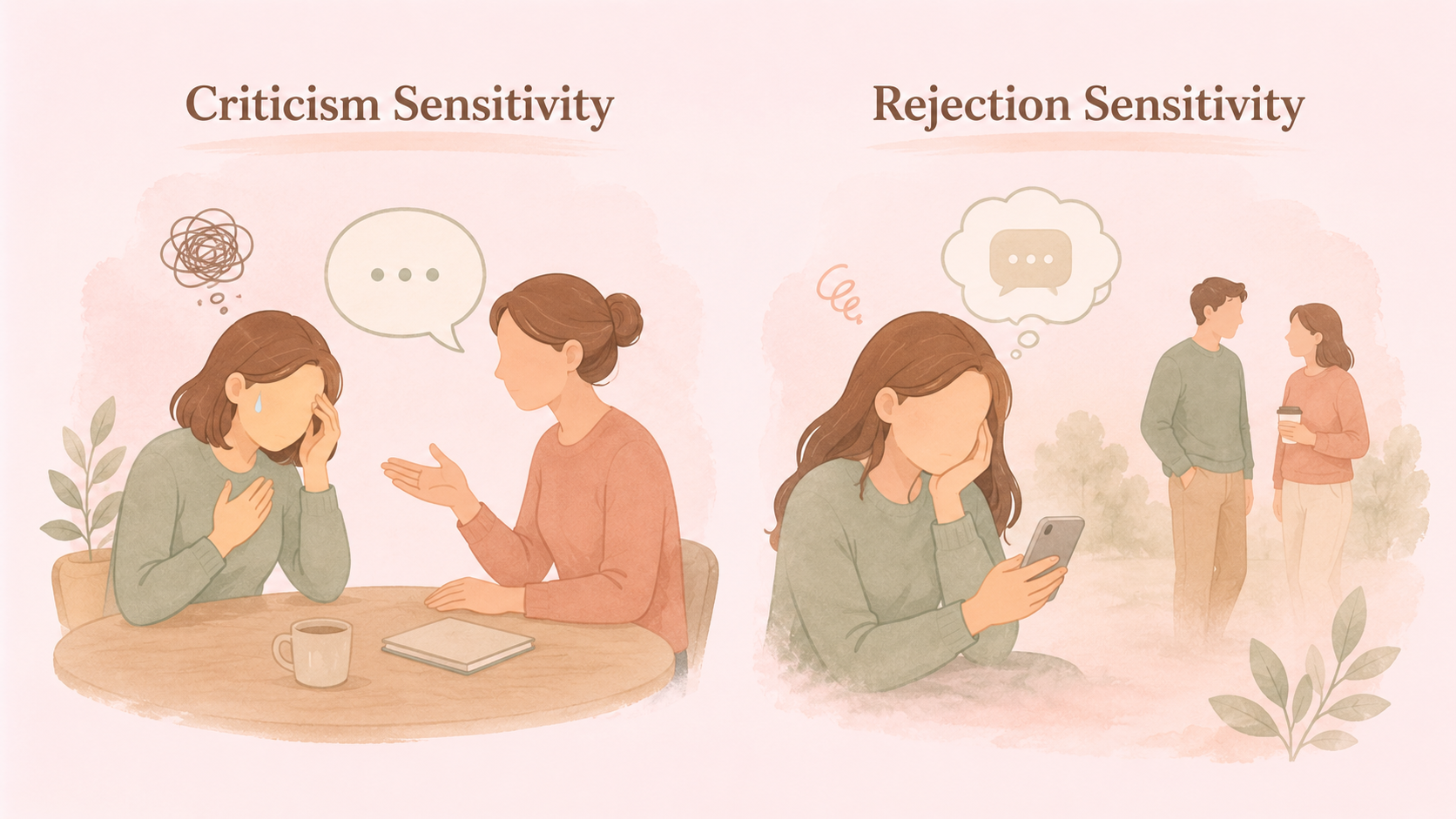
Criticism sensitivity is a strong emotional response to correction, negative evaluation, or perceived judgment. It often shows up after someone receives direct feedback or interprets a comment as criticism. The focus is usually on being seen as wrong, inadequate, disappointing, or flawed. A person may become defensive, tearful, ashamed, or preoccupied with the feedback long after the moment ends.
Rejection sensitivity is broader. It refers to a tendency to anxiously expect, perceive, or intensely react to rejection or exclusion. A person may feel rejected by criticism, but also by being left out, receiving a delayed response, sensing emotional distance, or being told “no.” In that sense, criticism sensitivity and rejection sensitivity can overlap, but they are not identical.
Someone may be sensitive to criticism without being broadly sensitive to rejection. For example, they may handle social disappointment well but feel devastated by professional correction. Another person may tolerate feedback at work yet spiral when a romantic partner seems less affectionate. Understanding the difference helps therapy focus on the actual trigger rather than collapsing all emotional pain into one category.
Criticism sensitivity itself is not typically described as a standalone mental health diagnosis. However, it may appear alongside or be influenced by anxiety, depression, social anxiety, trauma-related experiences, low self-worth, rejection sensitivity, and some neurodivergent experiences, depending on the person. It may also be intensified during periods of chronic stress or burnout. The pattern deserves care not because it automatically signals a disorder, but because it can meaningfully affect functioning and emotional well-being.
There is also no single clinical threshold at which “being sensitive to criticism” becomes pathological. People vary in temperament. A highly sensitive person, sometimes discussed using the term hsp, may be more emotionally responsive to social cues and environmental input. Research on sensory processing sensitivity suggests that people higher in this trait may show greater responsiveness to others’ moods and social pain, although “high sensitivity” is not itself a mental health diagnosis.
This section should be clinically reviewed before publication because broad diagnostic claims can easily become misleading. The more accurate framing is that criticism sensitivity may be one thread in a person’s broader emotional life. Whether it is primarily linked to temperament, stress, ADHD-related emotional regulation difficulties, trauma, or relationship patterns requires individualized understanding.
Zainib’s take on this is:
A good rule of thumb is when you notice that something is impacting your functioning, impacting how you show up in relationships, so much so that your attention is actually being drawn to a certain pattern that keeps showing up and actually negatively affects how you show up in relationships or how you show up in your life, it's a good time to consider how it works, how this, that you can get support. It's a good time to consider therapy so that you understand your own personal individualized experience and work on ways to support you.
At work or school, criticism sensitivity can make evaluation feel threatening. A person may dread performance reviews, avoid showing early drafts, struggle to ask questions, or interpret ordinary edits as evidence of failure. They may obsess over negative feedback even when their overall performance is strong. This can limit learning because feedback becomes something to survive rather than something to use.
A student who receives one corrective note on an otherwise strong assignment may ignore the positive comments and focus entirely on the single criticism. An employee may spend an entire weekend replaying a short remark made during a meeting. Over time, this pattern can contribute to Decision fatigue because every choice begins to feel loaded with the possibility of judgment. The person becomes not only tired of criticism but tired of trying to avoid it.
In relationships, criticism sensitivity can turn ordinary requests into emotionally charged moments. A partner says, “Could you text me if you are running late?” and the listener hears, “You are inconsiderate.” A friend says, “I wish you had told me sooner,” and the listener assumes the friendship is in danger. The reaction may be defensive, appeasing, withdrawn, or intensely apologetic.
This can place strain on romantic relationships and friendships alike. One person may feel they cannot raise concerns without triggering distress; the other may feel constantly attacked, even when the conversation is reasonable. If the pattern remains unspoken, both people can begin avoiding honesty. That avoidance may reduce conflict in the short term, but it often increases misunderstanding over time.
Internally, criticism sensitivity can fuel self-criticism, shame spirals, rumination, and perfectionism. The person may replay what happened, imagine how others now see them, or search for confirmation that they are still valued. They may feel overly sensitive and then criticize themselves for having the reaction, adding a second layer of distress. Instead of moving through one difficult moment, they become trapped in the aftermath of it.
This internal burden can spill into personal life. A person may cancel plans because they feel embarrassed, withdraw from loved ones because they fear being judged, or become too exhausted to engage after a day of trying to manage others’ expectations. In that way, criticism sensitivity can contribute to a larger pattern of social depletion and emotional narrowing.
You may be highly sensitive to criticism if you think about feedback for hours or days, become anxious before being evaluated, or apologize excessively after even minor mistakes. You may assume others are disappointed in you, avoid asking for help because corrections feel painful, or become defensive even when feedback is reasonable. Another common sign is difficulty distinguishing constructive input from a personal attack. The comment may concern one behaviour, but the mind translates it into a judgment of the whole self.
Some people also notice physical changes: a racing heart, tears, tightness in the chest, or a feeling that the nervous system has shifted into alarm. Others become mentally preoccupied, cycling through what happened and what they should say next. These emotional responses are real even when the original criticism was not severe. The goal is not to deny the reaction, but to understand it well enough that it no longer controls the next several hours or days.
Constructive criticism is feedback intended to help someone improve. Cambridge Dictionary defines it as comments that identify what is wrong with something in a helpful way and suggest how it can be improved. In communication guidance, constructive criticism is generally distinguished from destructive criticism by its specificity, respectfulness, and orientation toward growth rather than blame.
Still, even constructive criticism can hurt. The content of the feedback matters, but so does the listener’s emotional history. Tone, timing, power dynamics, relationship context, and past experiences can all influence whether a comment feels manageable or overwhelming. A well-intended suggestion offered when someone is already depleted may land differently than the same suggestion offered in a calm, supportive moment.
Feeling hurt does not automatically mean the feedback was unfair. At the same time, receiving feedback does not mean one’s worth is being judged. Both can be true: a comment can be useful, and the emotional reaction can still need care. That tension is often where therapeutic work becomes most meaningful, because the goal is neither emotional numbness nor automatic defensiveness, but a clearer separation between information and identity.

Coping with criticism sensitivity is not about forcing yourself to “be tougher.” It is about building enough emotional regulation that you can evaluate feedback before the reaction takes over. Some criticism deserves consideration. Some deserve context. Some deserve a boundary. A calmer internal state makes it easier to tell the difference.
If you feel activated, pause before responding. That may mean taking a breath, asking for a moment, or delaying a written reply until your body has settled. When the nervous system is in threat mode, feedback is more likely to be interpreted through fear than clarity. The pause protects both your emotional well-being and the quality of the response.
Try translating the comment into a narrower statement: “This piece of work needs revision,” rather than “I am incompetent.” Or, “My partner wants something handled differently,” rather than “I am failing in the relationship.” This distinction is simple in wording but often difficult in practice, especially for people with low self-esteem or perfectionistic standards. Repetition matters.
If feedback feels vague or alarming, clarification can reduce the mind’s urge to fill in the blanks. Useful questions include: “Can you give me an example?” or “What would improvement look like?” These questions shift the conversation from imagined criticism to concrete information. They also help reveal whether the feedback is actionable or simply poorly delivered.
Criticism sensitivity often involves a fast interpretive jump. The external message is, “This could be stronger.” The internal translation becomes, “I am terrible at this.” Identifying that leap can help restore proportion. The goal is not to pretend feedback never stings, but to notice when the mind adds a broader story of failure that was not actually stated.
Self-compassion matters because people learn more effectively when they are not using every mistake as evidence against themselves. Edits, corrections, and learning curves are normal. Even skilled people receive feedback. A compassionate internal stance does not reduce standards; it makes improvement less threatening.
Some people benefit from practicing feedback in lower-stakes situations. That might mean asking a trusted friend for input, sharing a draft before it feels perfect, or volunteering a small idea in a meeting. The purpose is not to provoke distress for its own sake. It is to build lived evidence that criticism can be uncomfortable without being catastrophic.
Not all criticism deserves equal weight. Feedback that is specific, relevant, and respectful is different from comments that are humiliating, contemptuous, or chronically belittling. Learning to cope with criticism should not mean tolerating mistreatment. Emotional maturity includes both receiving useful input and recognizing when someone’s delivery is harmful.
Here’s how Zainib coached a client to respond more effectively:
A client once told me that one of the most helpful things she learned through our work in therapy was that she could hold two truths at the same time. As someone who was highly sensitive and working in a fast-paced environment, it was helpful for her to understand that her system was more sensitive to the environment around her. At the same time, her sensitivity was valid, and so was the respect she deserved in the workplace. Part of our work was distinguishing that her boss’s criticism was not actually constructive. It was being used to micromanage her, and it was also interacting with a survival response she had developed: people-pleasing, questioning her own sensitivity, and placing other people’s interpretations of her experience above her own. Over time, she learned how to trust herself more. She learned that she could name and own her sensitivity without using it as a reason to accept disrespect. Her sensitivity was valid, and she still deserved to be treated with respect at work.
It may be worth speaking with a therapist if criticism regularly leads to intense shame, panic, withdrawal, or anger that feels difficult to regulate. Support may also be helpful if you avoid opportunities because evaluation feels unbearable, if feedback causes prolonged rumination or emotional distress, or if criticism sensitivity is harming work, school, friendships, or romantic relationships. You may also benefit from therapy if you suspect past experiences are shaping your reactions, or if you find yourself repeatedly seeking reassurance from loved ones after even mild disapproval.
Therapy can help clarify whether the pattern is rooted primarily in anxiety, self-worth, relationship dynamics, ADHD-related emotional regulation challenges, rejection sensitivity, or something else. It can also help you develop coping tools that are more sustainable than apologizing, withdrawing, or overworking to prevent criticism in the first place. The purpose is not to make you indifferent to feedback. It is to help feedback become information again, rather than an emotional emergency.
If criticism feels disproportionately painful or difficult to move past, a Wellnest therapist can help you explore what is driving the reaction and build healthier responses to feedback.
Final thoughts from Zainib:
I want to leave you with a reminder and a note of care: your sensitivity is not an indication of pathology, and it does not mean that something is wrong with you. Sensitivity to criticism may also be connected to your empathy, your attunement to other people, and your awareness of the world around you.At the same time, when vulnerability has not always felt safe, our systems can become incredibly skilled at building protectors. Sensitivity to criticism may develop as an adaptive response that tries to help us avoid big feelings like shame, fear, or vulnerability. When we can hold those younger experiences, or even older experiences, with care and compassion, we create more space to move forward. We can begin to bring that sensitivity, and all the magic it carries, into the world around us. There is often a dialectical experience here: being highly sensitive to criticism and the environment around us, while also being sensitive in deeply positive and meaningful ways.
You may be sensitive to criticism because feedback activates deeper concerns about self-worth, rejection, failure, or disappointing others. Past experiences of harsh criticism, low self-esteem, perfectionism, anxiety, and stress can all make comments feel more painful than they appear from the outside. Research also suggests that relational context matters: criticism from someone already perceived as critical may produce stronger hurt and distancing than the same comment from a safer relationship.
Some people with ADHD report heightened sensitivity to rejection or criticism, but the research is still developing and should not be overstated. A 2024 study found that higher ADHD scores were associated with higher rejection sensitivity in a college sample, while an earlier 2007 study did not find broadly elevated rejection sensitivity across all ADHD participants compared with controls. The most accurate answer is that criticism sensitivity and rejection sensitivity may be relevant for some people with ADHD, especially where emotional regulation difficulties are present, but they are not universal.
Criticism sensitivity is a pattern of strong emotional reactions to feedback, correction, or perceived judgment. A person may feel ashamed, defensive, tearful, preoccupied, or deeply hurt after receiving criticism, even when the feedback is mild or constructive. It is not usually considered a standalone diagnosis, but it can meaningfully affect relationships, work, and well-being.
Rejection sensitive dysphoria is often described as intense emotional pain triggered by real or perceived rejection, failure, or criticism. Cleveland Clinic notes that people with RSD may experience overwhelming shame, anger, sadness, or fear that feels difficult to regulate. Because rsd is not an officially recognized diagnosis, the term is best used carefully, but it can help some people describe an otherwise hard-to-name experience.
Criticism generally means evaluating something and identifying a fault, weakness, concern, or area for improvement. Merriam-Webster defines criticism as the act of criticizing or a critical observation or remark. In everyday life, criticism can range from thoughtful feedback on a piece of work to harsh negative judgment aimed at a person rather than the issue.
There is no single universally accepted three-part classification used across all fields. In practical communication settings, people often distinguish between constructive criticism and destructive criticism; some teaching frameworks add instructive criticism as a third type. Constructive criticism aims to help improvement, destructive criticism tears down without helping, and instructive criticism adds guidance or information to develop the work further.
To criticize is to express a judgment about faults, problems, or shortcomings in something. Merriam-Webster notes that “criticize” often implies finding fault, especially with methods, policies, or intentions. In healthy settings, criticism can be part of learning and refinement; in unhealthy settings, it can become shaming or controlling.
Another word for criticism may be critique, feedback, objection, disapproval, or negative evaluation, depending on context. Merriam-Webster defines “critique” as a critical estimate or discussion, which often sounds more analytical and less emotionally loaded than “criticism.” In therapy-oriented writing, “feedback” is often useful when the goal is to emphasize growth rather than fault.
Cleveland Clinic states that RSD is not an officially recognized medical condition and does not have a standard formal diagnostic process. Instead, a clinician may suspect the pattern based on the person’s described symptoms, their emotional responses to perceived rejection, and the presence of related concerns such as ADHD. Because the term is still clinically informal, anyone who identifies with it would benefit from discussing their experiences with a qualified provider rather than relying on self-diagnosis alone.
There is limited research on how long RSD lasts. Cleveland Clinic notes that, because RSD is not yet well defined in the research literature, its course and duration are not firmly established. Some people describe episodes of intense distress that are relatively brief but powerful, while broader patterns of rejection sensitivity may persist over time and warrant support.
Rejection sensitivity in ADHD refers to strong emotional responses to perceived rejection, disapproval, or criticism that some people with ADHD report. A 2024 study found that ADHD symptom scores were significantly associated with rejection sensitivity scores in a sample of college students, and a 2026 qualitative study explored rejection sensitivity as a lived experience among adults with ADHD. These findings suggest an area of meaningful clinical interest, while also showing why it is important not to treat every ADHD experience as identical.
It would be misleading to say that stalkers, as a group, are simply “overly sensitive to rejection.” Research on stalking describes a range of motives, including attempts to reassert power after a breakup, seek a relationship, or maintain unwanted control, and these behaviours are not explained by ordinary emotional sensitivity alone. Some stalking typologies do include rejected stalkers, but the issue is best understood through risk, entitlement, coercion, and behavior—not by minimizing it as hurt feelings.
A highly sensitive person (HSP) may process interpersonal cues deeply and become strongly affected by social tension, conflict, or emotional ambiguity. Research on sensory processing sensitivity has explored heightened responsiveness to others’ moods and social pain, suggesting why relationships can sometimes feel more emotionally demanding for highly sensitive people. At the same time, sensitivity is not inherently a problem; supportive, respectful relationships may feel especially nourishing when they are not dominated by unpredictability or criticism.
The phrase “absorb other people’s emotions” is not meant literally, but it can describe a familiar experience: noticing shifts in tone, tension, or affect so intensely that another person’s mood begins to shape your own. Research on sensory processing sensitivity suggests that highly sensitive individuals may show deeper processing of emotional and interpersonal cues, and some studies have examined greater sensitivity to others’ moods. In daily life, this may mean that conflict, disappointment, or emotional heaviness in loved ones feels especially difficult to set down.
Becoming less reactive to criticism usually involves strengthening emotional regulation, separating feedback from identity, and practicing self-compassion. It can help to pause before responding, ask for clarification, evaluate whether the criticism was constructive, and notice when the mind turns one comment into a global judgment of self-worth. If criticism sensitivity leads to avoidance, emotional flooding, or ongoing distress, therapy may help you understand the pattern and build more stable responses over time.
Join our Nest to learn more about:


